There’s a moment in this job that nobody outside it really understands, and if I’m honest, we don’t always talk about it properly inside it either. It’s not the dramatic moments—the blue-light runs, the big trauma jobs, the cardiac arrests where you’re sweating through your shirt and time feels like it’s bending. People assume those are the highs. Sometimes they are.
But there’s another kind of high in paramedicine, a quieter one, and it comes from something that looks almost boring from the outside: getting the diagnosis right. Not just “sort of right”. Not “probably right”. Properly right.
That feeling—when you walk out of a house with a working diagnosis in your head, and it sits there like a fragile glass ornament you’re trying not to drop—only to find out later that the hospital confirmed it. That’s your judgment; you held that your clinical reasoning wasn’t a lucky guess or a coin flip. That the instinct you trusted was correct. It’s the moment the doubt finally shuts up.
Here’s the truth: doubt is never far away. It doesn’t matter how many calls you’ve done, how many times you’ve seen a pattern, or how many times you’ve handled chaos with a steady voice. Every honest clinician will tell you the same: certainty is rare. Pre-hospital care is built on incomplete information and imperfect environments. You don’t get the immediate blood results. You don’t get scans. You don’t have the luxury of sitting someone down in a quiet cubicle with a full history and a detailed timeline. You don’t get the luxury of lifting the phone and getting a specialist to come and help with your assessment.
You get a living room, a patient who might be confused or frightened, a relative talking over them, a medication list that may or may not exist, and your own clinical judgement trying to piece it together in real time. So, when you think you know what’s going on, there’s always a second voice in your head asking, “Are you sure?”
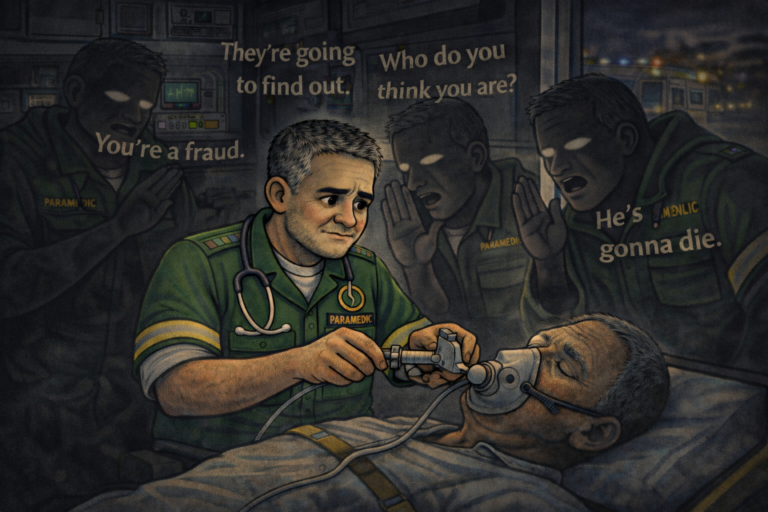
That voice is part of being safe. It keeps you careful. It keeps you from becoming arrogant. It stops you from charging down a single track when the situation might have ten different explanations. But that voice can also be exhausting, because it doesn’t always arrive politely as “consider differential diagnoses.” Sometimes it arrives as anxiety. Sometimes it arrives as imposter syndrome dressed up as caution. Sometimes it arrives as the fear that if you get this wrong, you won’t just feel embarrassed—you’ll harm someone.
And that’s the part people don’t see: the weight of “getting it right.”
A lot of ambulance work is about decisions made without certainty. You assess. You observe. You interpret. You treat. You decide whether to convey, refer, escalate, call for backup, pre-alert, or make this a time-critical transfer or a safe, steady transport with reassurance. Those decisions aren’t always dramatic, but they matter. Every decision carries responsibility.
I’ve lost count of the times I’ve walked away from a patient with a diagnosis in my mind and a knot in my stomach. Not because I didn’t know what I was doing, but because I did—because I knew what was at stake.
Take chest pain, for example. It’s one of the most common presentations we see and one of the most psychologically heavy. Chest pain is a category of complaint that can be absolutely nothing—musculoskeletal pain, indigestion, or anxiety—or it can be the beginning of something catastrophic. In a living room at 4 am, you don’t get a troponin result. You don’t get a CT coronary angiogram. You get history, vital signs, and a 12-lead ECG. You get your own eyes and ears. You get your own experience.
Sometimes the ECG is clear. Sometimes it’s so obvious from what you see on the monitor—your crewmate’s already walking back to get the carry chair—but often it isn’t. Often, it’s subtle. It’s borderline. It’s that frustrating grey area where the patient doesn’t look awful, but something feels wrong. That’s where the doubt lives.
You’re trying to decide if you’re looking at something evolving, something early, something being masked by pain tolerance or denial, or something completely benign that feels scary because it involves the chest. When you choose to escalate—when you pre-alert, when you activate pathways, when you set the tone that says, “This could be serious”—you feel the pressure because if you’re wrong, you’ll worry you’ve wasted time, resources, and attention. You’ll worry you’ve created drama. You’ll worry that your colleagues in the hospital will roll their eyes and mentally file you under “overcautious”.
Nobody wants to be that clinician. Nobody wants to be known as the one who cried wolf, but if you’re right and you don’t escalate, someone gets harmed.
That’s the constant tightrope, and it’s not just chest pain. It’s stroke symptoms that come and go. It’s sepsis that starts as “just a bit off”. It’s a ruptured ectopic pregnancy that initially looks like abdominal pain and dizziness. It’s a pulmonary embolism hiding behind mild breathlessness. It’s meningitis that looks like flu until it doesn’t. It’s the diabetic whose sugar isn’t that low, but whose behaviour is wrong.
You might put the elderly patient’s confusion down to dementia, but it may be an infection, hypoxia, or bleeding. The job is full of moments when you build a picture from incomplete pieces, under pressure.
When I was younger in the job, doubt felt like a sign of incompetence. I thought experienced clinicians were certain. I thought real paramedics walked into a house and instantly knew what was wrong, the way TV doctors do—confident diagnosis, dramatic conclusion, straight to treatment. It took years to realise that’s not how good clinicians operate. Good clinicians operate with probabilities, not certainty. They form a working diagnosis and hold it lightly, always ready to adapt as new information appears.
But that intellectual understanding doesn’t always stop the emotional side. You can know, logically, that doubt is part of safe practice, and still feel the stress of it in your body. You can still feel that internal tension when you hand over to ED and you’re saying, “I’m concerned about…” and you’re trying to sound confident while the voice in your head whispers, What if you’re wrong? What if you missed something obvious? What if they scan them and it’s nothing, and you look like an idiot?
That moment—handover—can feel like stepping into a spotlight. You’re standing in a busy department, surrounded by staff who are tired and overloaded, and you’re trying to deliver a clear picture. You’re advocating for your patient. You’re trying to ensure they don’t get parked in a corridor and forgotten. The doubt remains because the outcome isn’t known yet.
You leave the patient in their care. You return to the ambulance, and the doubt follows you out the door like a stray dog that has decided you’re its master now.
It sits in your head as you restock. It sits there as you clean equipment. It sits there as you write the ePRF, re-reading your own words like you’re proofreading a legal statement. You check the vital signs again. You look at the ECG again. You question whether you interpreted it correctly. You remember the patient’s face and wonder if you missed a subtle sign. You run through differentials like a mental roulette wheel.
And then the shift moves on. The MDT bleeps again. Another call. Another patient. Another crisis. You don’t get to sit and reflect properly because the job doesn’t pause. So the doubt gets parked. Not resolved—parked.
Sometimes you never get closure. Many patients disappear into the hospital system, and you never hear what happened to them. You don’t find out if your diagnosis was right. You don’t find out if your concern was justified. You don’t find out if that subtle sign was the key to something bigger. You move on, carrying the uncertainty like background noise.
But sometimes—sometimes—you get the confirmation.
It might come from an ED nurse you know, passing you in the corridor and saying, “You were right about that one.” It might come from a doctor who tells you, “Good spot.” It might come from the patient later, if you see them again, saying, “They said it was a clot,” or “They said it was sepsis,” or “They said it was a bleed.” It might come through the grapevine in the station, in that informal way information travels: “That patient you brought in last night? Turned out to be…”.
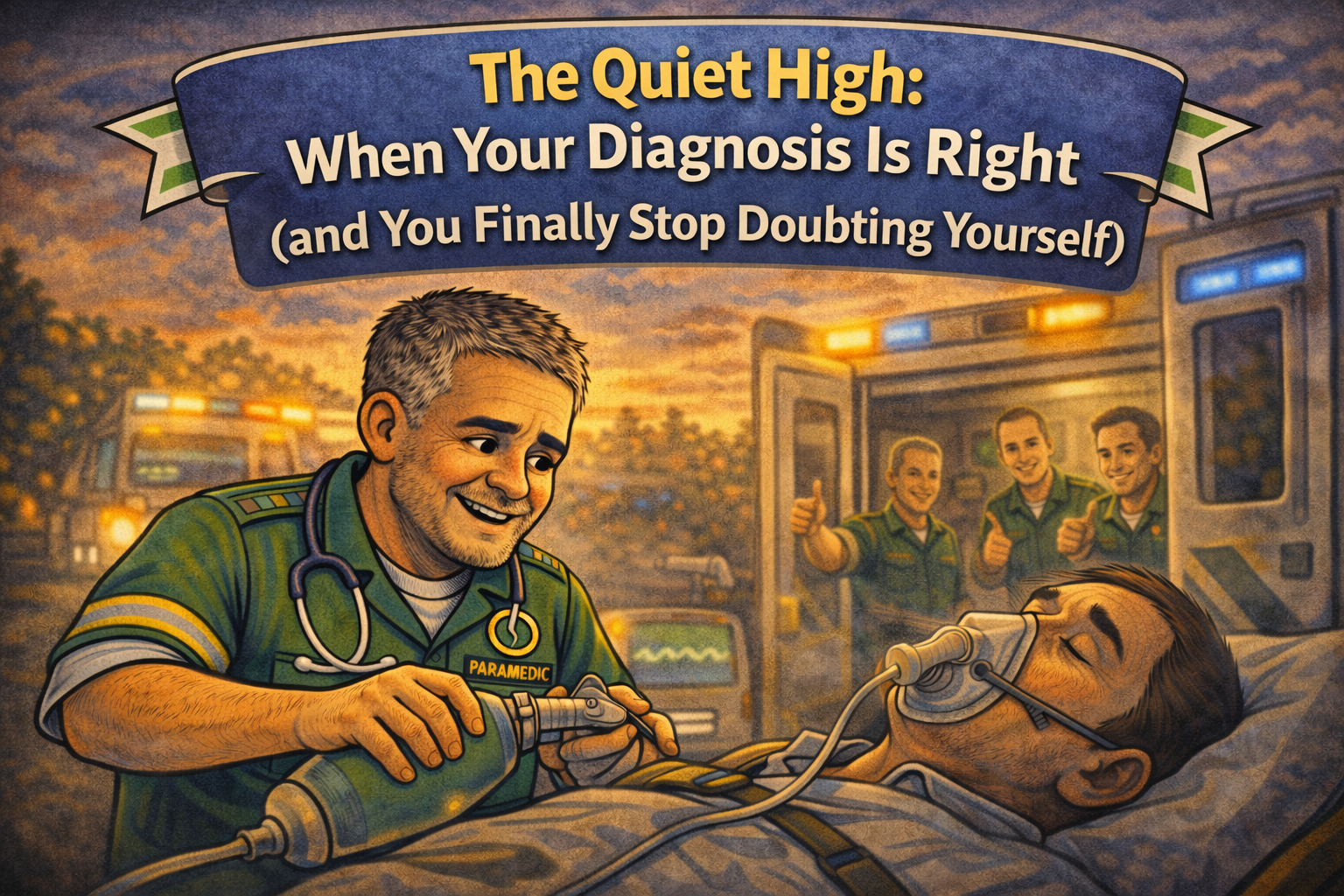
And when you hear it, something inside you unclenches.
The doubt doesn’t just quiet—it switches off completely for a moment. It’s like your brain stops holding its breath.
The joy of that moment is hard to describe because it’s not loud joy. It’s not jumping up and down. It’s not a celebration. It’s a deep, quiet relief that feels almost physical. It’s the knowledge that, under pressure, you saw what you needed to see, that you made the right call when it mattered.
It’s also validation in a profession where validation isn’t always offered. Ambulance work is often a job of endings without endings. You arrive, you intervene, you leave. You rarely see the final chapter. So when you do get a piece of the ending—when you find out you were right—it’s like a small but significant closure.
And it’s not about ego, even though it might sound like it. It’s about safety. It’s about knowing your decisions protected someone. It’s about knowing that if you hadn’t acted, if you hadn’t escalated, if you hadn’t trusted your concern, the outcome could have been worse.
The joy is really relief with a pulse.
It’s the opposite of that horrible feeling when you realise you’ve missed something later. That feeling—the cold drop in the stomach when you hear a patient deteriorated or died and you wonder if you could have done more—is one of the most unpleasant sensations in the job. It can haunt you. It can make you replay the call. It can make you doubt yourself for weeks. It can make you hypervigilant in future jobs.
So when you get it right, it’s not just joy. It’s protection against that shadow.
It also changes you in small ways. Each confirmed diagnosis becomes internal evidence. It teaches you what subtle signs mean. It strengthens your pattern recognition. It adds to that quiet library of experience you carry. Over time, those moments accumulate and form the foundation of real confidence—not the loud confidence of ego, but the grounded confidence of competence.
And still, the doubt returns.
That’s the funny thing. You can be right ten times and still worry on the eleventh. That doesn’t mean you haven’t learnt. It means the job stays uncertain. It means you’re still aware of responsibility. It means you haven’t become complacent.
There’s a phrase we use sometimes—half-joking, half-serious—about “gut feelings”. It’s that moment where you can’t fully explain what’s wrong, but you know something is wrong. That sense is built from thousands of calls and tiny patterns: the tone of a voice, the way someone sits, the way their skin looks, the way they answer questions, and the slight mismatch between how they appear and what their vital signs show. Those instincts aren’t magic. They’ve accumulated experience.
But when you act on them, you still worry. Acting on an instinct requires confidence, and confidence is always being challenged by the very real possibility of being wrong.
That’s why the confirmation matters so much. It’s not just personal satisfaction. It’s feedback. It’s learning. It’s calibration.
When you are on a call with the Air Ambulance, you usually receive an email with details about the patient’s injuries and where they were admitted to the hospital. In an ideal world, paramedics would regularly receive structured feedback on all outcomes. We would know what happened to the patients we transported. We would close the loop. We would learn systematically, but in a busy system, feedback is sporadic. You get what you get. Sometimes you get nothing at all.
So when you do get confirmation, it matters. It lands like a small gift. It reminds you that you’re not just guessing. You’re practising.
And it can be oddly emotional. Not in a dramatic way. More like a quiet internal warmth. Sometimes it hits you later—on the drive home, in the shower, when you finally stop moving—and you realise you’ve been carrying stress about that job all day without fully acknowledging it. You realise you’ve been waiting for permission to relax. The confirmation gives you that permission.
I’ve had jobs where I was almost certain and still worried. Jobs where everything in my assessment said one thing, but my brain insisted on holding open the possibility that I’d missed something. That’s the paramedic paradox: the more you know, the more you know what can go wrong. Knowledge doesn’t always bring comfort. Sometimes it brings awareness of risk.
But when you hear those words—”you were right”—it does something powerful. It restores trust in yourself. It quiets the imposter voice. It tells you that your experience and your reasoning are real. It tells you that nineteen years isn’t luck.
And then, because this is the ambulance service and we can’t have nice things for long, the radio goes on again.
Another call. Another uncertainty. Another diagnosis built from fragments. Another moment where you’ll walk out of a house carrying a fragile working theory in your head and wonder if it will be confirmed.
That’s the job. It’s a constant cycle of assessment, doubt, action, and hope.
But here’s what I’ve learned after nineteen years: the doubt isn’t the enemy. Uncontrolled doubt is. Doubt that makes you check again, reassess, consider differentials, and stay humble is part of safe practice. Doubt that paralyses you or convinces you you’re a fraud is the bit you have to manage.
And the joy—when you’re right—that joy isn’t about being right for its own sake. It’s about knowing you did what the patient needed. It’s about knowing your decisions mattered. It’s about the relief that you didn’t miss something that could have harmed someone.
It’s quite high. The kind you don’t post about. The kind you might only mention in the station with a small smile and a shrug. The kind you might downplay because that’s what we do: “Aye, sure… it was obvious,” even though it wasn’t obvious at all.
But inside, you’ll feel it: a small unclenching, a brief moment of calm, and the steady satisfaction that, for once, the voice in your head has nothing left to argue with.
And that’s enough.