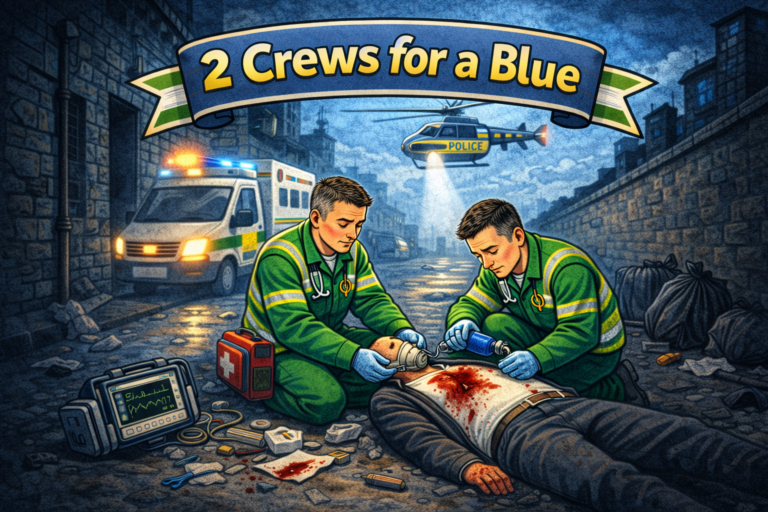
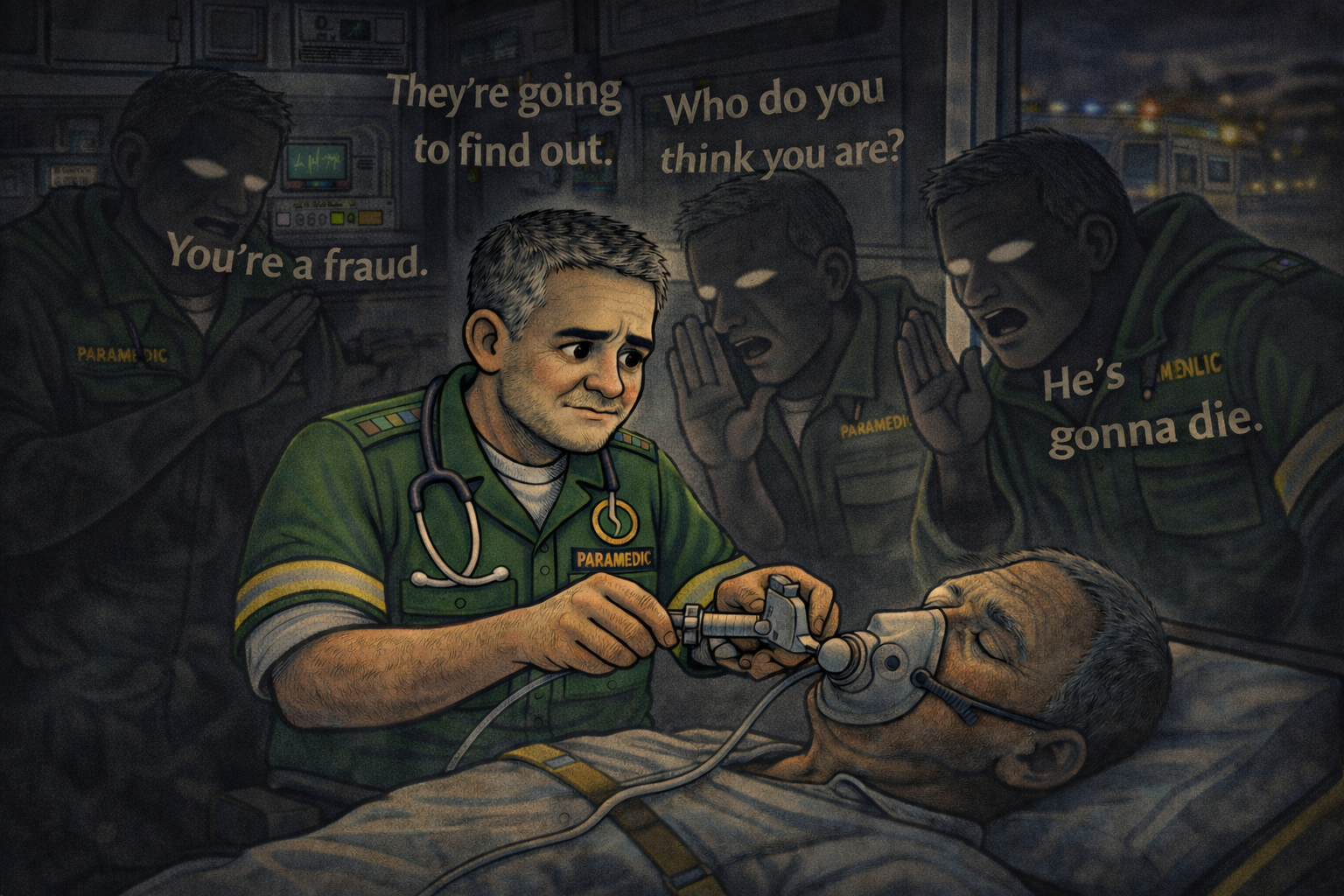
In the Ambulance Service, we become masters of the poker face. Whether it’s a Category 1 Cardiac Arrest in a cramped terrace house or a multi-vehicle RTC on the M1 with enough flashing lights to be seen from space, we step out of the ambulance with a very specific gait. It’s a walk that says, Don’t worry. I’m here. I know exactly what I’m doing. It’s confident. It’s calm. It’s the walk you learn because patients and families don’t need to see your internal processing. They need stability. They need someone to take control. They need the person in the green uniform to look like the situation is manageable—because if you look rattled, everyone else will be rattled too. The problem is that, for a huge chunk of my nineteen-year career, while I was projecting that calm authority, a voice in the back of my head was whispering something completely different: You’re a fraud. You’ve just been lucky so far. Today’s the day they realise you’re winging it. That’s the paradox. You can be the calmest person in the room while your own brain is running a private inquiry into your competence.
Welcome to the world of imposter syndrome in pre-hospital care.
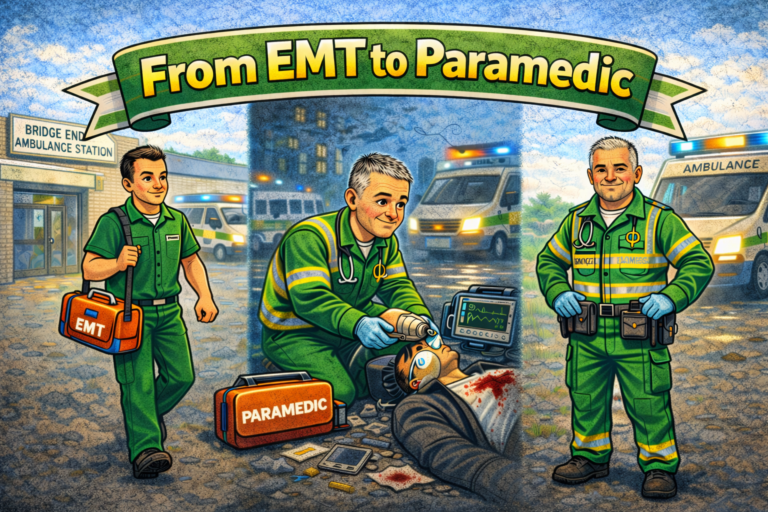
People imagine imposter syndrome as if it’s only for office jobs, like it’s something that happens to a new manager staring at a spreadsheet or a student who’s convinced everyone else understands the assignment. But it thrives in emergency medicine because emergency medicine is built on uncertainty. You are constantly making decisions in imperfect environments with incomplete information. You don’t have the luxury of long consults, controlled lighting, or a full team standing around a bed with all the notes laid out. You’ve got a living room, a stairwell, a roadside ditch, an anxious family, and a patient who can’t always tell you what’s wrong—or is telling you, but in a way that isn’t tidy or linear and in the middle of that, you’re expected to be decisive. That expectation alone is enough to feed the imposter because the imposter isn’t interested in facts. It’s interesting in doubt. When I was an EMT, the shield was easier to wear. If things went truly sideways—if the patient deteriorated suddenly, if the job turned into something beyond routine—I could look at the Paramedic and wait for the lead. That doesn’t mean EMT work is easy; it isn’t. EMTs carry a massive operational load and often keep the entire job moving. But in that hierarchy of clinical responsibility, there was a comfort in knowing someone else had the final call. I can’t say when it actually started, but it slowly increased, especially when things went wrong on calls, or I couldn’t remember or think what I should do in different situations, when everyone else seemed to be doing simple tasks or skills that I should automatically be doing. Failures in tests and exams in our Quarterly assessments just seem to ‘add fuel to the fire’ of my Imposter syndrome.
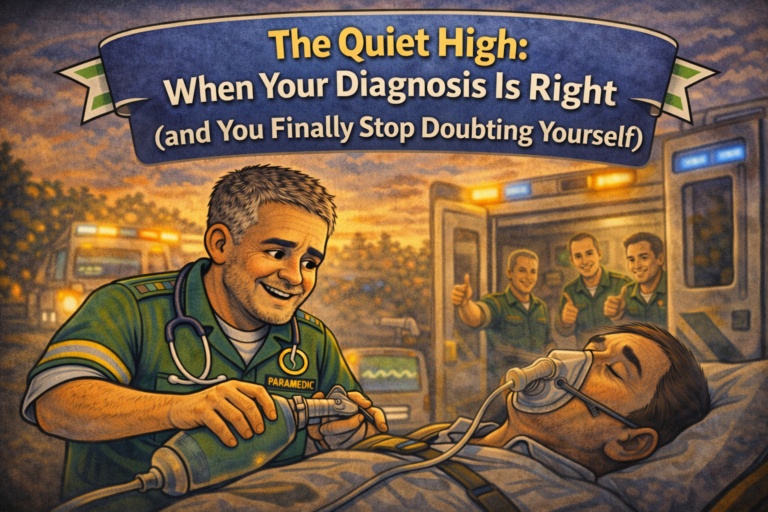
Then I stepped up. Going through my Paramedic training was probably the highest point in my imposter syndrome crisis that I ever had. So much so that in a meeting with the course director, I almost gave up the course due to the feelings I was experiencing. They assured me that I was more than capable of finishing the course, and I’m glad I took their advice and stayed. After successfully finishing my Paramedic degree course, I went from having the green stripe epauletes on my shoulders to having the yellow stripe epaulettes with the word Paramedic on my shoulder. I got the authority to sign out the ‘big boy’ drug bag —an innocent-looking bag that contains enough power to stop a heart, start one, relieve pain, clot blood, reverse an overdose, and tip a stable patient into instability if you got it wrong. Suddenly, I wasn’t supporting the decision. I was making it. There is a specific type of vertigo that hits you when you realise you are the highest clinical authority in a certain radius. You stand over a patient, the family is looking at you like you’re a minor deity, first aiders, first responders, ACA’s and EMTs are waiting for an instruction, and for a split second, you feel like a child wearing their parent’s oversized uniform. You’re standing there thinking, Surely someone more qualified is about to walk in? Surely the real paramedic is stuck in traffic, and I’m just filling in? That’s imposter syndrome in its purest form: you feel like your role is a costume you borrowed and you’re waiting for someone to ask for it back. One of the hallmarks of imposter syndrome is the inability to internalise success. And that is dangerous in this job because success is not always dramatic. Success is often quiet. It’s the patient who survives. The patient who settles. The pain that comes down. The airway that stays patent. The decision to convey—or not convey—that turns out to be correct. The difficult handover was delivered clearly. The escalation was made early. The risk is spotted before it becomes a disaster. But the imposter doesn’t care about that. When a job goes well—when ROSC happens, when the airway management is slick, when the scene is controlled, and the patient improves—the imposter doesn’t think, I am a skilled clinician. It thinks: the stars aligned, that patient was an easy save, my crewmate did the heavy lifting, we just got lucky, or anyone could’ve done that
.
We attribute our wins to luck and our near-misses to incompetence. The problem is that after nineteen years, it becomes hard to pretend you’re still “just lucky.” Luck doesn’t last two decades. You don’t survive nineteen years of shifts by accident. You don’t make thousands of decisions, manage hundreds of high-stakes calls, and keep turning up through nights, storms, fatigue, and pressure by pure chance, but tell that to a brain that’s been wired to doubt itself since the first time it heard a siren. Sirens do something to you. People outside the job hear a siren and think of urgency. People in the job hear a siren, and their body starts preparing before their mind has caught up. That’s not drama—it’s conditioning. Heart rate up. Breathe shallow. Focus narrowing. The job does it automatically, because over the years, you learn that the sound of urgency usually means someone is about to rely on you. Someone is about to need you to be competent. Someone is about to need you calm. Imposter syndrome lives in that gap between what you can do and what you fear you can’t do. Northern Ireland adds its own flavour to this, because culturally we are not known for grand emotional honesty. We are known for understatement. We are known for sarcasm. We are known for dealing with things by talking around them rather than through them.
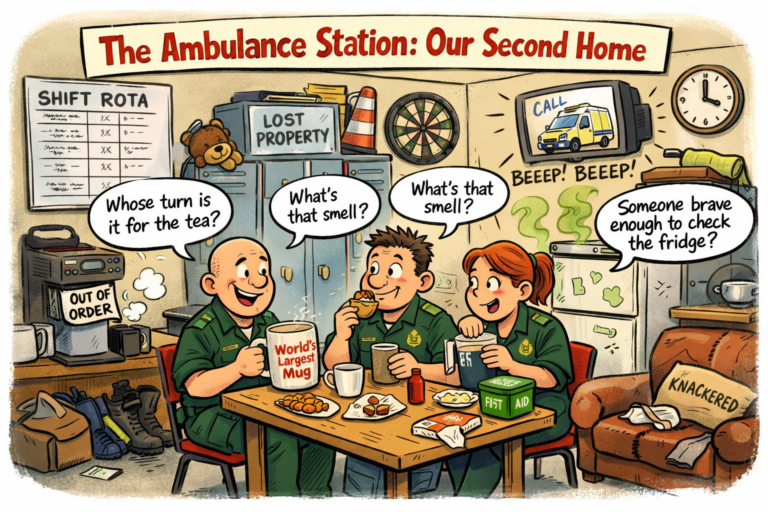
If you ask someone in Northern Ireland how they’re doing, the answer is rarely “I’m struggling.” It’s “Aye, I’m grand.” or “I’m dead on”, and “grand” in this place can mean anything from genuinely fine to hanging on by the fingernails. In station life, we don’t always do emotional debriefs very well. We do tea. We do dark humour. We do slagging. We complain about our backs, our knees, the missed meal, the paperwork, and the fact that the pen you had ten minutes ago has disappeared into an alternate dimension. That humour is armour. It’s how we reset between calls. It’s how we release pressure without collapsing under it, but humour also creates a problem: it makes it hard to say, out loud, I felt completely out of my depth on that last call, because if you admit doubt, you worry you’ll be seen as weak or not up to the job. You worry that the moment you say, That rattled me, someone will quietly file it away and decide you’re not safe, not reliable, not good enough. So you bury it. You go back to the station. You make tea. You slag yourself for missing lunch again. You joke about needing a new spine. And all the while, the imposter sits on your shoulder like a wee courtroom clerk taking notes for the next job. Imposter syndrome isn’t just a mental game. It’s physical. It’s the reason your heart rate is 110 before you even reach the front door. It’s the reason you feel your jaw tighten when the dispatcher’s tone changes. It’s the reason your stomach drops when you hear the word “child” attached to a call. It’s the reason you get that prickly adrenaline feeling in your arms when you’re climbing out of the ambulance. It’s the reason you can do everything right on scene and then spend three hours after shift re-reading your ePRFs, checking for a spelling mistake, a missed observation, a detail that might later be questioned.
That’s what the imposter does: it makes you audit yourself to death, and that level of self-surveillance is exhausting. It doesn’t just tire you out emotionally; it drains you physically. When you combine the high-stakes pressure of paramedicine with the chronic realities we all joke about—missed meals, bad backs, irregular sleep, constant switching between calm and chaos—you get a recipe for burnout. You are running on adrenaline and anxiety, a cocktail that eventually corrodes even the most resilient medic. You can only “push through” for so long before your body and brain start sending stronger signals. The dangerous part is that, in our culture, “pushing through” is often praised. We praise the colleague who never complains, who always picks up overtime, who never seems rattled. We call them solid. We call them granite. We assume they’re fine. Sometimes they’re not fine at all. They’re just quiet. So how do you survive nineteen years with a fraudster living in your head? For me, it started with acknowledging something basic: there is a gap between what you know and what you feel. And feelings are not always reliable measures of competence. On a bad day, you can feel useless. On a good day, you can still feel like you’re bluffing. Neither feeling automatically reflects reality. Reality is what you do, repeatedly, under pressure. Reality is the decisions you make and the outcomes that follow, even when you’re tired and even when the environment is imperfect.
One of the most useful things I learnt was to trust the nineteen years of muscle memory, not the five minutes of panic. Panic is loud. Experience is quiet. Panic shouts, You’re going to mess this up. Experience just starts moving—checks, assessments, actions—because you’ve done it before. The trick is letting experience lead while panic talks in the background, and another thing that helped—more than I expected—was talking to other experienced staff. Not dramatic heart-to-hearts in a circle. Just honest moments. The kind of quiet honesty that happens when you’re cleaning equipment together or driving back to station at 3 am and the world is dark and you’re both too tired to pretend and here’s what shocked me: the people I looked up to—the ones who seemed made of granite, the ones who walked into chaos like it was a mild inconvenience—often admitted they felt the same. They had the same flicker of doubt. They had the same moments of thinking, Surely I should be better at this by now. They had the same post-job replay running in their heads. That was a turning point, because it reframed the feeling. It wasn’t a personal defect. It was a feature of working in a job where the stakes matter.
There’s also a reality we don’t like admitting: perfection is the enemy of the paramedic. The public sometimes imagines we work in controlled conditions. We don’t. We work in ditches, in rain, in cramped bedrooms, in stairwells, in moving vehicles, in noisy environments, sometimes in unsafe environments. We work with limited space, limited light, limited information, and limited time. We are not aiming for perfection. We are aiming for safe, effective care delivered under constraint. So I started adopting a more realistic standard—one that experienced clinicians tend to develop, whether they say it or not: the “good enough” medic. Not careless. Not lazy. Good enough in the sense that you delivered competent, appropriate care in a difficult environment, and you left the patient better—or at least no worse—than you found them, with a clear plan and a safe handover. The truth is, if the patient got to the hospital better than they were when you arrived, you did the job. If you recognised deterioration early, managed risk, communicated properly, and acted appropriately, you did the job. If you didn’t have all the answers but you made the best decision you could with the information available, you did the job. The imposter hates that standard because it wants certainty. It wants absolute proof. It wants you to be flawless so it can finally relax. But flaws are part of being human, and in this job, being human is not a weakness—it’s what keeps you connected to the people you treat. To the student paramedic reading this: if you feel like you don’t belong, congratulations. It means you care enough to be terrified of getting it wrong. That fear, in moderation, is useful. It keeps you careful. It keeps you checking. It keeps you humble. The goal isn’t to eliminate fear; it’s to stop fear from controlling you.
Confidence without fear becomes arrogance. Fear without confidence becomes paralysis. The art is balancing them—being humble enough to question yourself, and competent enough to act anyway.
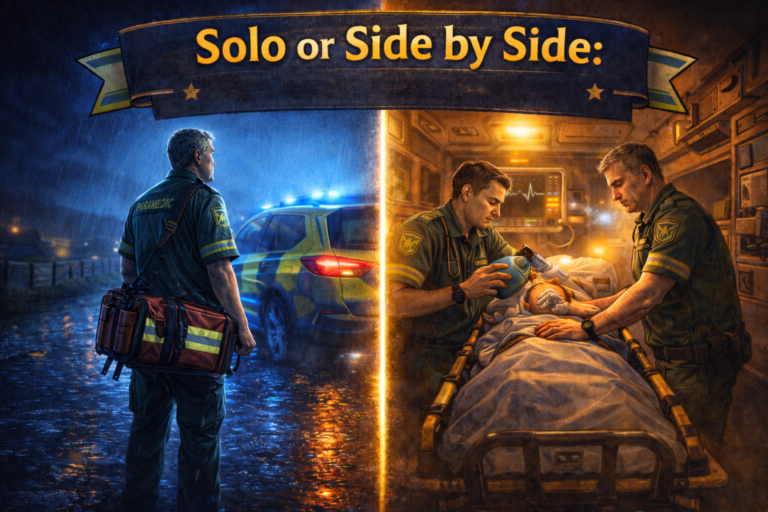
To my fellow veterans: it’s okay to admit that sometimes, even now, when the blue lights are reflecting in the rain on the windscreen, you still get that fleeting thought that someone is about to tap you on the shoulder and ask for the uniform back. You’re not alone in that. You’re not broken for feeling it. You’re just still aware of the responsibility because responsibility is heavy. And if you’re doing the job properly, you feel the weight of it. I’m nineteen years in. I’ve missed meals. I’ve ruined my back. I’ve laughed at things that would horrify anyone outside the service, because it was either laugh or carry it raw. I’ve fought the imposter on quiet shifts and busy shifts, on easy calls and brutal calls, on nights where everything went smoothly and nights where nothing did. Some days I’ve felt like a clinician. Other days, I’ve felt like I’m one mistake away from being exposed as a chancer who wandered into the wrong uniform, and I’m still here. Not because the imposter disappeared. It hasn’t. It still whispers sometimes. But I’ve learned to recognise it for what it is: not a prophecy, but a reaction. Not evidence of incompetence, but evidence that I care. Evidence that I understand the stakes. Evidence that I haven’t become numb. The paradox of being a paramedic is that you can spend nineteen years saving lives and still carry a private fear of being found out. But maybe that fear—kept in check, kept in perspective—is part of what keeps you safe. It stops you from becoming complacent. It keeps you learning. It keeps you honest. It keeps you grounded.
So if you’re waiting to be “found out,” you’re probably not a fraud. You’re probably a conscientious clinician in a job that doesn’t hand out certainty, and if you’re still turning up—still doing the work, still trying to be calm in other people’s chaos—you’ve already proven the one thing that matters most in this job: you’re present. The uniform isn’t borrowed. It fits, and even if that voice in your head hasn’t caught up yet, your nineteen years of decisions have.