In the Ambulance Service, the station is not merely a building or logistical hub; it is a high-pressure ecosystem governed by a series of unwritten laws that often carry more influence than any Trust policy or clinical guideline. From the outside, most stations appear unremarkable — functional structures hidden on industrial estates or tucked behind busier buildings, largely unnoticed by the public who see them only as places ambulances come from and return to. Yet for those who spend years passing through their doors, the station becomes something far more significant. It evolves from background infrastructure into a constant presence within a profession defined by unpredictability.
Early in a paramedic’s career, the station is simply a base. You report there, collect your equipment, check the vehicle, and wait for the next call. Your attention is fixed firmly on clinical competence — remembering drug doses, refining assessments, learning how to communicate under pressure, and, perhaps most urgently, getting through shifts without making mistakes that feel disproportionate to your level of experience. At that stage, the station is little more than operational scenery. That perception changes with time.
As the years accumulate, the station becomes one of the few constants in a role shaped by interruption, urgency, and emotional extremes. No matter how chaotic a shift becomes, you return to the same doors, the same faint smell of instant coffee, the same worn chairs that have outlasted multiple generations of staff. You might never describe the environment as comfortable, yet the familiarity provides a quiet reassurance. In a profession where very little is predictable, predictability itself becomes a form of comfort.
Every station has its own personality — something you sense almost immediately when you walk through the door. Some are loud, fuelled by banter and constant conversation. Others are calmer, their atmosphere shaped by unspoken understanding rather than noise. Regardless of temperament, all stations share a subtle but unmistakable quality: they are not simply workplaces. They function as holding areas between calls, decompression chambers after difficult jobs, and for many clinicians, places where more waking hours are spent than at home. The shift begins long before the tannoy sounds.
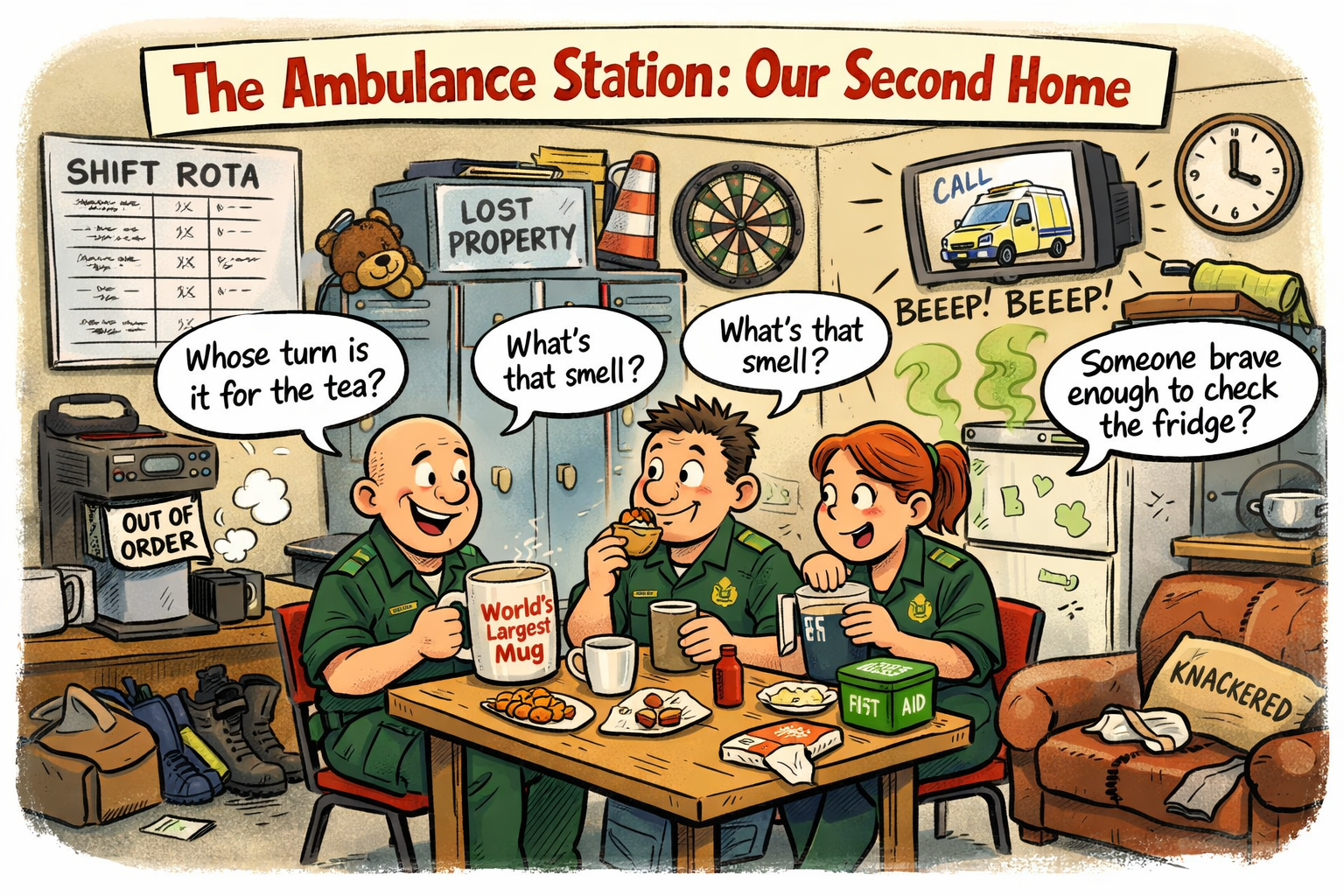
Crews arrive in staggered rhythms, each person following a routine refined through repetition. Bags are placed in familiar corners. Jackets are draped over chairs that unofficially belong to certain individuals. Mugs appear without discussion, claimed through longstanding habit rather than ownership. No one assigns these patterns; they emerge organically over time. Sit in the wrong chair, and you quickly discover that some traditions require no documentation to be enforced. Staff working the A&E ambulances sat at one table, the non-emergency Patient Care Service (PCS) or as they were more commoningly know as “wee men”, sat at another table and dare the two sit together or at each other’s tables.
At the heart of the station sits the crew room — an understated but vital space where the hidden curriculum of ambulance life is learned. Universities may teach physiology, pharmacology, and the intricacies of the Krebs cycle, but it is here that you absorb the social mechanics required to survive a career on the road without losing either your composure or the respect of your peers.
Conversation in the crew room moves fluidly between the trivial and the profound. One moment might centre on a faulty toaster; the next, on a quietly delivered observation about a colleague’s difficult shift. There are rarely formal check-ins or emotional declarations. Support is typically subtle, often communicated through humour, shared silence, or the simple act of making someone a cup of tea without asking. It is understated, deeply human, and remarkably effective.
Stations operate according to rhythms that experienced staff learn to read instinctively. Day shifts feel different from nights; weekends carry their own tempo. Sometimes the building hums with anticipation — crews half-prepared, bags zipped, radios monitored. At other times, an uneasy quiet settles in, the kind that breeds suspicion among seasoned clinicians who know that silence rarely predicts calm. More often than not, it signals the opposite.
Within this environment, informal mentorship thrives. Newly qualified staff arrived wide-eyed and uncertain, absorbing lessons without ever being formally taught. We watched how experienced clinicians prepared for shifts, how they decompressed between calls, and how they spoke about the job without explicitly discussing its emotional weight. No one scheduled those teachings. They occurred through proximity, observation, and shared experience. Over time, stations developed memory.
Certain incidents are referenced years later with nothing more than the phrase, “Remember that night…,” immediately transporting everyone present back into a shared moment. Stories accumulate, sometimes retold with slight variations depending on the narrator, but always reinforcing a collective identity. Photos on walls, outdated notices, and nicknames that make little sense to outsiders all contribute to a quiet historical record. Without noticing, you become part of that history yourself — until one day a colleague references a job from years past and you realise you were there.
Food, too, plays a surprisingly important role in station culture. Half-eaten meals, impromptu takeaways, and well-intentioned but short-lived attempts at healthier eating create moments of normality within an abnormal profession. Sitting down together after a demanding sequence of calls grounds people. It reminds everyone that beneath the uniform and clinical responsibility are simply individuals doing a difficult job.
Stations are also repositories for frustration. Conversations about workload, systemic pressures, management and operational inefficiencies surface regularly — rarely dramatic, often pragmatic, occasionally cynical. Yet these discussions serve an essential function. They act as pressure valves, acknowledging the realities of the profession without allowing them to dominate it. Perhaps most importantly, stations are places where people are noticed.
If someone who is usually talkative becomes quiet, it is observed. If a colleague skips the crew room when they normally wouldn’t, it is registered. This awareness develops naturally through shared time and space; no formal welfare checklist can replicate it. Support often begins not with structured intervention, but with the simple recognition that something has shifted.
The station reflects the contradictions inherent in ambulance work. It can feel painfully slow for hours, only for crews to be dispatched from one intense call to another without pause. The physical building remains unchanged — what evolves is your relationship with it. Early in your career, everything feels personal: feedback, getting ridiculed for mistakes, even silence. With experience comes perspective. You begin to recognise that people cope differently. Some seek conversation and noise; others require distance and quiet. Both approaches are accepted, provided mutual respect is maintained.
You also begin to notice how experienced staff carry themselves — calmer, more deliberate, less compelled to fill silence. They understand that the job will provide enough noise soon enough.
As careers progress, stations often become anchors. Clinicians may change roles, relocate, or advance professionally, yet many remain emotionally tied to the station where they first found their footing. It is where they learned what competence felt like, where early anxieties gradually gave way to confidence, and where relationships formed that sustained them through the most demanding periods of their careers. A quiet pride frequently emerges around these spaces. Stations are rarely glamorous. Many are outdated, cramped, or held together by temporary fixes that somehow became permanent. Still, crews defend them fiercely. External criticism is often met with immediate resistance — even if identical complaints were voiced internally moments earlier. The station, imperfect as it may be, is theirs.
Professional identity is shaped here as well. Not through formal policy, but through behaviour — how colleagues treat one another after difficult shifts, who steps forward when someone struggles, what is valued, and what is quietly discouraged. These observations guide developing clinicians far more powerfully than written directives. Humour thrives within station walls. It is seldom performative; rather, it tends toward the dry, observational, and occasionally brutally honest. This humour keeps the profession grounded. It offers psychological distance without detachment, allowing clinicians to remain human in a role that routinely exposes them to humanity at its most vulnerable.
As healthcare systems evolve and operational pressures intensify, the station often feels like the final point of stability. Demand rises, expectations expand, and resources stretch thin, yet the station remains a place where crews gather, regroup, and reset before stepping back into uncertainty. Its importance is frequently underestimated by those who have never depended on it. At the end of a shift, leaving the station carries different emotional weights depending on the day. Sometimes it is relief — the quiet satisfaction of handing over the vehicle and knowing nothing more is required of you. Sometimes it is the lingering presence of unfinished business, calls that resist easy closure. Other times, it is simply exhaustion paired with acceptance. Regardless, there is always the understanding that you will return.
After enough years in the service, a realisation settles in: the station is not just a building. It is a shared space shaped continuously by the people who pass through it. It holds routines, relationships, private understandings, and countless moments that never appear in clinical records yet define the professional experience. It is where paramedics are most themselves — not actively responding, assessing, or performing, but existing in the brief intervals between intensity. Conversations pause mid-sentence when tones activate, only to resume hours later as though no time has passed. Life, in that sense, is perpetually suspended and restarted within those walls.
For all the unpredictability of ambulance work, the station offers something rare: continuity. It is the place crews return to repeatedly, regardless of how the shift unfolds. And over time, without any formal agreement, it becomes something more than a workplace. It becomes a second home — not because of the structure itself, but because of the people, the shared experiences, and the quiet understanding that within those ordinary walls, extraordinary work begins and ends.