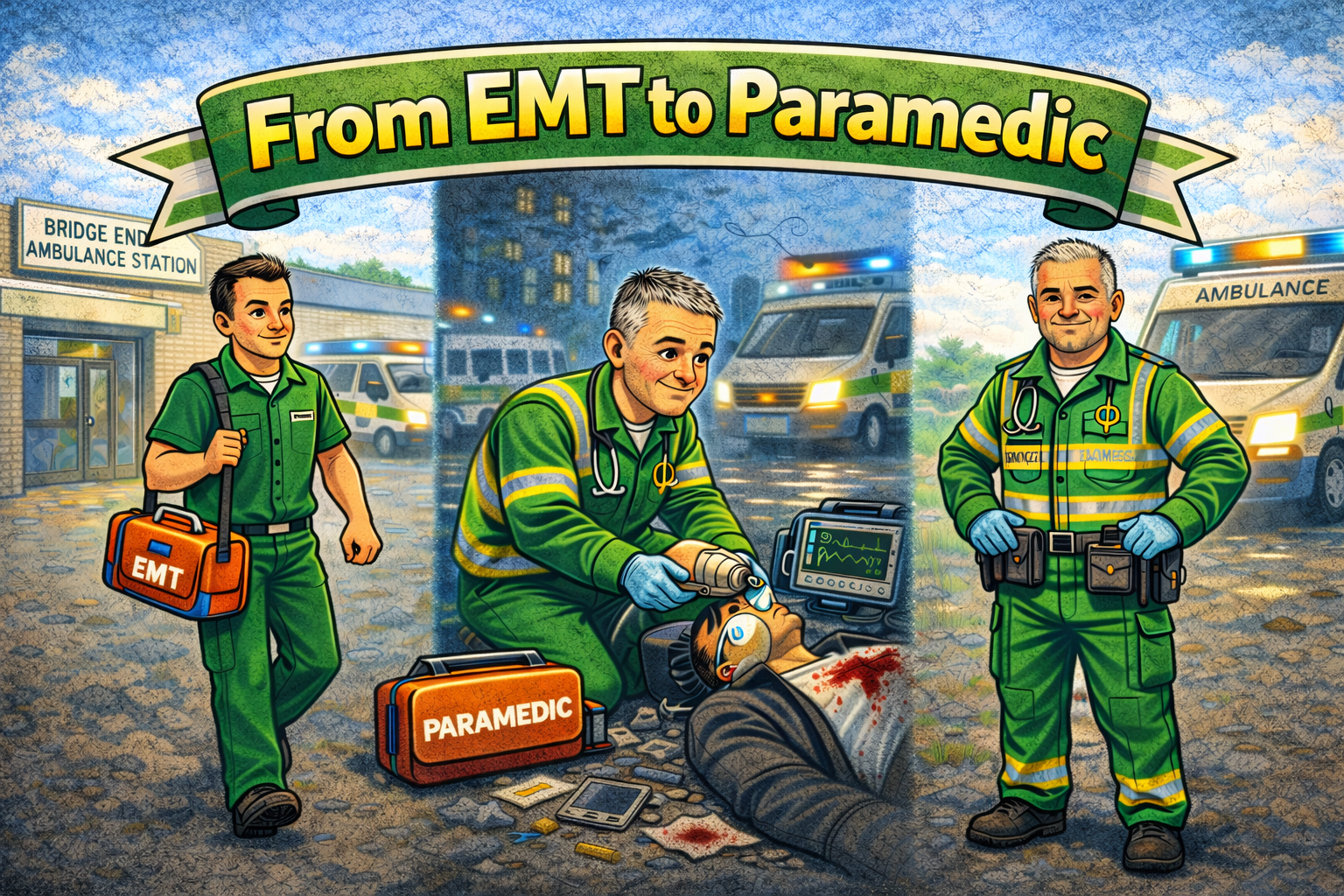
The funny thing about moving from EMT to paramedic is that, from the outside, it looks like nothing changes: same green uniform and same station doors.
Ambulances still have 4 wheels, radios still drop out, same roads, same rain that seems to fall sideways in Northern Ireland to keep things interesting. And yet, internally, when we all were given a paramedic bag when you qualified, it’s like someone quietly swapped your previous paramedic crewmates’ bag and filled it with bricks, handed you a pen that never works when you need it, and then said, “Right—now you’re responsible for the decisions. Enjoy.”
That’s the upgrade. Same uniform. Much bigger headache. I spent fourteen years as an EMT and then stepped into the paramedic role, and if there’s one thing I learned, it’s that becoming a paramedic wasn’t simply “more skills.” It’s more weight. More judgment. More expectation—mostly from yourself, but also from everyone else, including patients, families, and the healthcare system, which now looked at me like a mobile solution to every gap it couldn’t fill. Being an EMT made me capable. Becoming a paramedic made me accountable in a different way. And the difference between capable and accountable is where the headache lives.
There’s a particular kind of competence that grows in EMT work. It’s grounded, practical, and often underappreciated. You learn to function in the real world—not the classroom world. I learnt the rhythm of shifts when you had to ring up to get your shifts every week, the personality of stations, and how quickly a plan could collapse the moment the tannoy bleeped. I learnt patient handling and the art of extracting someone from a bathroom built in 1972 with a doorway that was clearly designed for a broom, not a stretcher or carry chair. I learnt that “access difficult” was a polite way of saying, “The Police might have to force entry” I learnt the difference between clinical urgency and operational urgency—both matter, but they don’t always arrive together.
You also learn the human side of the job long before you master the clinical. How to calm someone down when they’re frightened. How to de-escalate a room full of anxious relatives, each one convinced they know best. How to speak to someone embarrassed they’ve called, or furious they had to. You become a translator between panic and process. And you get good at the invisible work. The pace. The scene management. The steady presence. The quiet reassurance that turns chaos into something manageable.
As an EMT, I was often the anchor. You’re the person making the scene workable while your crewmate gets hands-on with the advanced clinical drug administration or intubation. You keep the job moving. You keep the patient safe. You keep your crewmate safe. You’re watching for hazards, watching for changes, watching for what the patient isn’t saying. You’re doing a hundred things that aren’t glamorous but are essential. If you stay long enough, EMT work becomes an identity. Not in the dramatic sense. In the way you move through scenes. In the confidence you develop without needing to announce it. In fact, you can walk into a house and know, within thirty seconds, whether the job is going to be smooth or whether you’re about to spend the next hour negotiating with someone’s uncle who “knows about medicine” because he once watched an episode of Casualty.
The EMT role gave me a set of instincts that are priceless. It taught me how to operate under pressure before I ever have to lead under pressure. That matters more than people realise. At some point, though, I felt the pull to progress. Maybe it was ambition. Sometimes it was the desire for more clinical involvement. Sometimes it was simply that I had been doing the role long enough to know you could contribute at a higher level. I learned the job from the ground up, and I wanted to take the next step. After all, many of my colleagues often wondered why I hadn’t done it years ago.
What they don’t tell you—at least not clearly enough—is that stepping up to Paramedic isn’t just stepping up in skill. It’s stepping up in decision ownership. As an EMT, I could often lean into the shared nature of decisions. The crew is a unit. I’d contribute, I’d support, I’d challenge when needed. But the paramedic role comes with a subtle shift in how people look at me, and how I look at you. The weight of “final call” creeps in.
It’s not that you become a dictator in the ambulance—good crews don’t work like that. It’s when the decision is made that you feel it land on your shoulders differently. I’m now the person whose clinical judgment is most likely to be questioned after the fact. I’m the one the patient and family often assume has the answers. I’m the one who has to explain why I’m not doing what they think should happen. And the job does not wait for me to get comfortable with that. One of the strangest parts of becoming a paramedic is that the calls don’t change. The job list is the job list. I’m still going to have falls, chest pain, breathing difficulties, “unwell person,” mental health crises, social calls, repeat callers, nursing home jobs, and everything in between.
But your brain changes. Or rather, it has to. As an EMT, I assessed, I supported, I anticipated. As a paramedic, I assess, and I commit. I don’t just think, “This could be X.” I think, “What’s most likely, what’s most dangerous, what evidence do I have, what am I missing, and what is my plan?” Your tolerance for uncertainty changes, too. The job never gives you perfect information, but the paramedic role forces me to work with ambiguity while still making definitive decisions. That’s a skill that takes time, and it’s uncomfortable at first, especially if you’re conscientious.
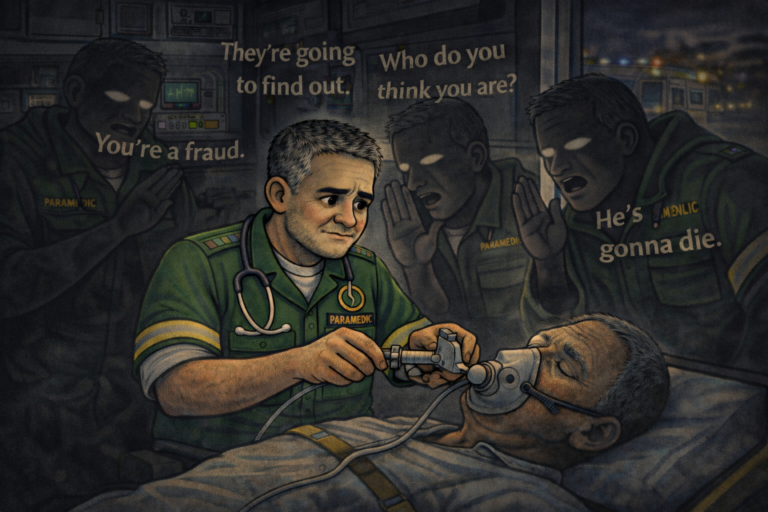
Conscientious clinicians suffer the most during transition. They replay decisions. They second-guess. They wonder whether their confidence is arrogance or whether their caution is cowardice. They don’t just want to be right; they want to be safe, fair, and appropriate. The headache lives there: in the desire to do the right thing in an imperfect system. If you want to know the real difference between EMT and paramedic, it’s this: expectations multiply.
Patients expect more from you. Not always clinically, but psychologically. The word “Paramedic” carries weight. People associate it with authority, expertise, and solutions. They assume I can fix the situation. They assume I can override delays. They assume I can force the hospital to take them immediately. They assume I can produce a bed, a doctor, and a miracle on request. Families expect me to know what’s happening instantly. To reassure them. To give them certainty. To tell them what’s going to happen next. Hospitals expect a clear clinical narrative. A structured handover. A rationale they can trust.
The ambulance service expects a standard. Documentation, decision-making within guidelines, and I expect the best of myself. That’s the bit that quietly causes the biggest stress. I know what’s at stake, even on “simple” calls. A sore chest might be reflux. It might be something else. A collapse might be dehydration. It might be an arrhythmia. A confused patient might be infected. Might be hypoglycaemia. Might be something more sinister. The paramedic brain is trained to hold all those possibilities while still acting decisively. That’s not a skill you switch on. It’s a skill you build. Yes, the paramedic scope expands. More medications. More interventions. More assessments. More tools.
But the irony is that with more tools comes less simplicity. In EMT work, I sometimes keep things direct: assess, stabilise, convey when appropriate, support. As a paramedic, I often operate in the grey zones. I am determining pathways. Deciding whether a patient needs conveyance or can be safely managed at home. Deciding whether they’re appropriate for alternative care. Deciding whether “not going” is safe or a future incident report waiting to happen. The hardest part isn’t the advanced skills. It’s the decisions around risk. A paramedic spends a lot of time thinking about probabilities. Not just “what is this?” but “what is this most likely to be?” and “what is the worst thing this could be, and how confident am I it isn’t that?” That’s a heavier mental process, and it runs constantly. Paramedic autonomy is a privilege. It’s also a burden. Being able to make independent decisions is empowering, but it also means I can’t hide from the consequences of those decisions. In a hospital, there are layers. There are teams. There are consultations.
There are handovers and escalations built into the system. In the ambulance, I’m often the system. I can ring for advice, I can consult pathways, I can follow guidelines—but the immediate responsibility still sits with me. That autonomy becomes especially heavy when I’m dealing with patients who don’t fit neat categories. Vulnerable adults. Mental health crises. Social deprivation. Substance use. Chronic illness that’s gone unmanaged. People who call because they’re lonely, frightened, or stuck. These are not “medical emergencies” in the narrow sense, but they are emergencies in the way they impact a person’s life. And ambulance services—whether we like it or not—are often the catchment net. As an EMT, I witnessed this. As a paramedic, I’m asked to solve it. That’s the bigger headache. Being a frontline clinician in a system where I can see the gaps clearly, but can’t always fill them. If EMT work has paperwork, paramedic work has documentation with teeth.
My clinical record is no longer just a summary of what happened; it’s a rationale. It’s my evidence. It’s the explanation for why I made the decisions I did. It’s the voice that speaks for me later, when memory fades, and someone asks, “Why did you do that?” And you learn quickly that memory is not admissible evidence. The notes are.
It becomes a strange mental discipline: doing the job, managing the scene, thinking clinically, communicating with the patient and family, coordinating with your partner, and simultaneously anticipating how to document this in a way that is accurate, defensible, and clear. Some days it feels like you need a second brain just for documentation. Other days, I wonder if your job title should be “Paramedic / Part-Time Historian of Chaos.”
A subtle but real shift happens when you become a paramedic. People start coming to you for “the call.” For the decision. For the final word. That can be uncomfortable if you’re naturally collaborative—which most good clinicians are. The best paramedics are not authoritarian. They listen to their EMT colleagues, their partners, their patients. They make decisions with humility, not ego. But even when you’re collaborative, you still become the decider in many situations. You feel it in conversations with other services. You feel it in the expectations around your clinical judgement, and you feel it in your own head, when you’re lying awake after a shift replaying a job and thinking, “Was that the right call?”That’s the paramedic headache. It follows you home sometimes. Quietly. Like a low-level ringing in the ears.
Now, to be fair, it’s not all headaches and existential dread. Becoming a paramedic also brings a deeper sense of professional satisfaction. I have more ability to intervene, to treat, to make a tangible difference. I can relieve pain, reduce distress, manage complex presentations, and provide a level of clinical care that I couldn’t deliver before. You also gain mastery over time. The decisions that felt heavy at first become more natural. Not because I cared less, but because my judgment becomes calibrated. I’ve learnt how to work with uncertainty without being paralysed by it. I’ve learnt how to make decisions safely and stand by them, and perhaps most importantly, I have gained the ability to mentor. To support the next generation. To be the calm voice for someone who’s where I used to be. To create a culture where learning is normal and asking questions is safe. That’s where the job starts to feel like a craft. Not just tasks, but wisdom. If I’m honest, the best part of becoming a Paramedic after many years as an EMT is that you bring something invaluable into the role: grounding.
I already learned scene management. I already learned how to speak to people. I already learned how the ambulance service works in reality, not in theory. I know how to pace a shift. I know what fatigue feels like and how to work safely within it. I know how to build trust quickly, because I’ve done it for years. That EMT foundation made me a better paramedic. It kept me humble. It kept me practical. It stopped me from becoming a guideline robot who forgot there’s a person attached to the symptoms. You’re less likely to be seduced by the “advanced” aspects of the role and more likely to focus on what actually matters: patient care, safety, communication, and sound decision-making. The irony is that paramedicine looks like an upgrade in skills, but it’s really an upgrade in responsibility. The EMT years prepared me for that responsibility better than any classroom ever will. So yes, it’s the same uniform. People still call you “ambulance driver.” You still eat food as if it’s your last meal. You still get jobs at ten minutes to the end of the shift that make you question the fairness of the universe.
But the headache is bigger because the role is bigger. The stakes feel heavier because I understand them more clearly. The decisions matter because they ripple beyond the moment. And if you’re doing it right, I’ll always feel a little weight. That’s not a weakness. That’s responsibility. Becoming a paramedic doesn’t stop learning. It means I start learning in a new way: through judgment, accountability, and the quiet art of making the best call I can with the information you have. That’s the job. That’s the shift. That’s the uniform. Same green. Bigger headache.
And, somehow, still worth it.