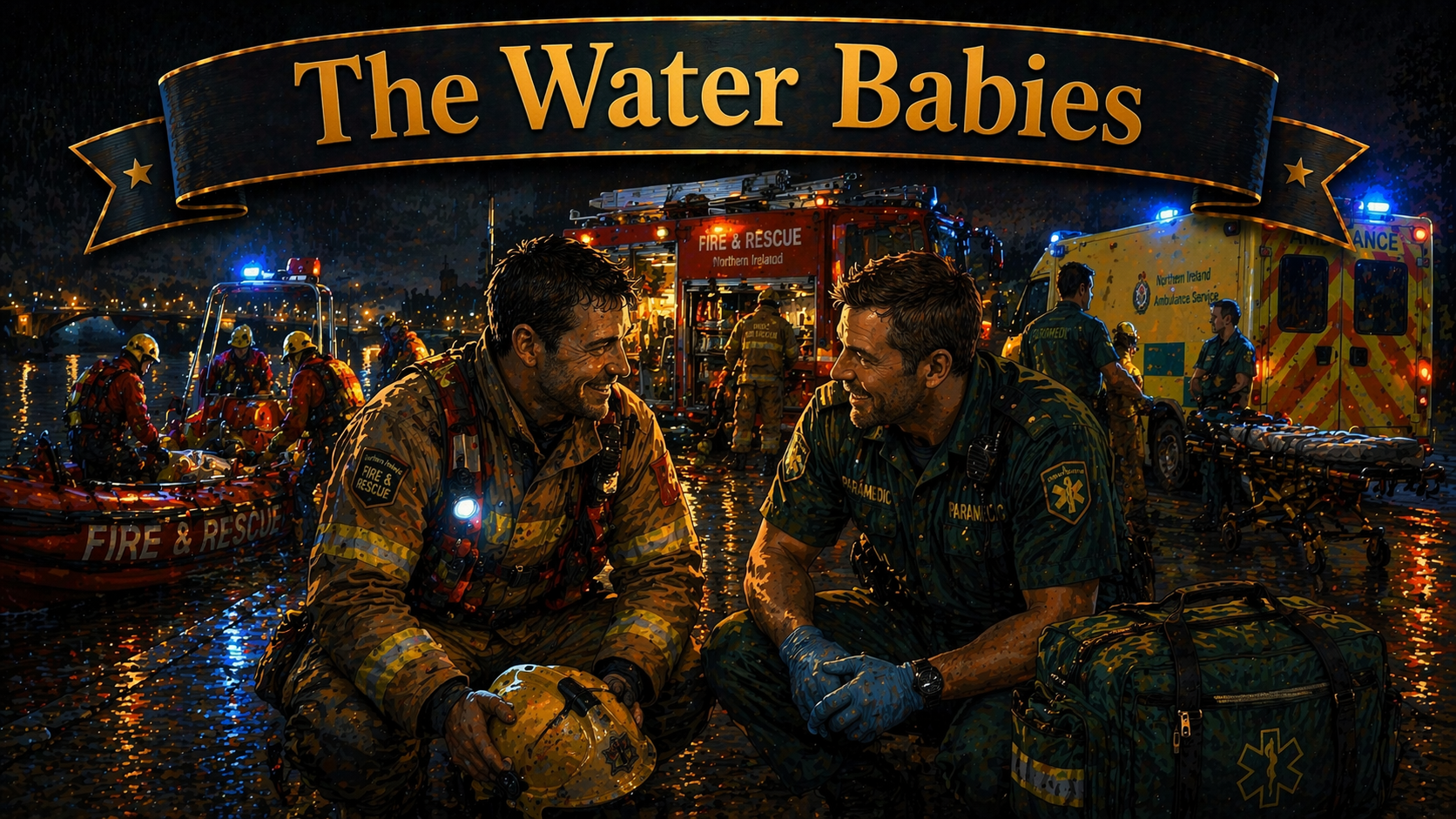
There is no manual for the relationship between the ambulance service and the fire service. Nobody sits you down and explains it. You just turn up to enough jobs together and somewhere along the way it forms — part professional respect, part mutual bewilderment, part something that functions very much like affection even when it sounds nothing like it.
Over nineteen years in the Northern Ireland Ambulance Service I worked alongside the Northern Ireland Fire and Rescue Service more times than I could count. At road traffic collisions and major incidents and water-based emergencies and everything in between. In daylight and darkness and in the early hours of the morning when the rest of the world was asleep and the two of us — ambulance and fire — were the ones who had turned up. Through all of it, through every scene and every job and every moment of genuine professional respect, one thing remained constant. The slagging never stopped.
It starts, as most things in emergency services do, with a nickname. The Northern Ireland Fire and Rescue Service has earned several over the years, but the one that has stuck, the one that gets deployed with the particular affection that only comes from genuine familiarity, is the water babies. It is not an insult. It is barely even a criticism. It is simply an acknowledgement of what the fire service does with water — enthusiastically, comprehensively, and at a volume that suggests they have never encountered a situation that couldn’t be improved by the application of significant quantities of it. The water babies. Said with a smile. Meaning, broadly, that we know you, we have worked beside you, and we are glad you are here even when we are laughing at you.
The water tends to come after the cutting. This is the other great constant of working alongside the fire service at road traffic collisions. They arrive with their hydraulic rescue equipment and their considerable expertise in vehicle extrication and their absolute conviction, developed over years of training and operational experience, that the best way to get a patient out of a damaged vehicle is to remove as much of the vehicle as possible. Doors. Roofs. Pillars. The entire side of the car if the situation calls for it, and sometimes if it doesn’t quite call for it but the equipment is there and the opportunity has presented itself.
As an ambulance clinician standing at the edge of the scene, waiting to get to your patient or sometimes sitting beside them in the vehicle, you develop a complicated relationship with this process. Extrication done properly is genuinely impressive — coordinated, skilled, the kind of calm under pressure that takes years to develop. But you are standing there watching your patient through a windscreen while an entire vehicle is systematically dismantled around them, and occasionally the thought crosses your mind that the door might have just opened.
You don’t say this out loud. Or if you do, you say it quietly to your crewmate, and you both have a private moment with it, and then you get on with the job. Because the fire service knows what they are doing and the patient will be out when they are out and your role right now is to be ready when that moment comes.
Your instinct is to get in. To reach the patient. To start doing something useful with your hands. The clinical brain does not cope well with standing at the edge of a scene watching other people work. But that waiting is not wasted time. It is the fire service making the environment safe enough for you to do your job without turning one patient into two. Collapsed structures. Unstable vehicles. Hazards invisible from the outside until someone who knows what to look for has assessed them. They create access. They create safety. They make it possible for the rest of what follows to happen without adding to the problem.
What you are definitely not doing, while all of this is happening, is sleeping.
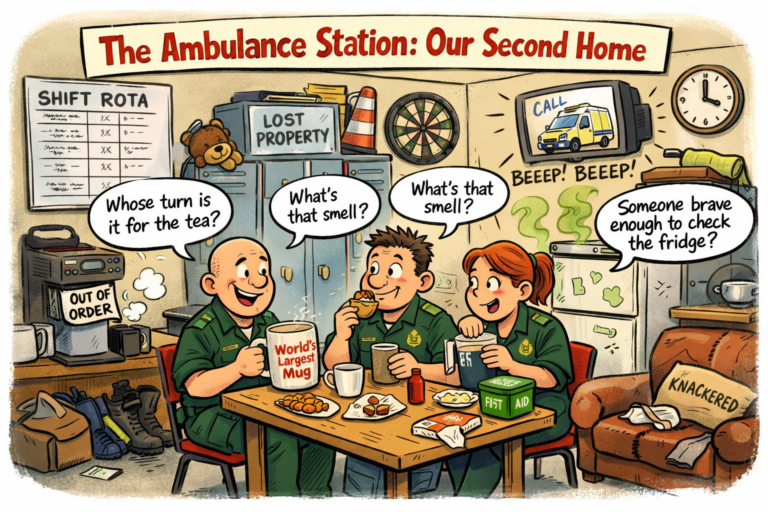
This is perhaps the most significant cultural difference between the ambulance service and the fire service, and it deserves to be addressed directly and without rancour because it comes up constantly and is a source of considerable comedy on both sides. The fire service has beds. Actual beds. In their stations. Firefighters on night duty, once the calls allow, can sleep. They have rest facilities and gyms with actual equipment in them and the kind of station infrastructure that an ambulance crew, pulling into a battered station kitchen at three in the morning looking for a functioning kettle, can only regard with a mixture of awe and indignation.
The gym particularly deserves mention. Fire stations in Northern Ireland have gym facilities that would not embarrass a mid-range leisure centre. Proper equipment. Weights. Cardiovascular machines. Space to actually move around in. The ambulance service, meanwhile, has a kitchen. Sometimes the kettle works.
The beds and the gym feed into a particular ambulance service tradition, which is the post-call debrief on fire service working conditions, conducted in the cab on the way back to station and consisting largely of increasingly elaborate speculation about what it must be like to have a designated sleeping area during a night shift. The speculation is always affectionate. It is also always slightly pained. Because the ambulance crew asking these questions has been on the road since the shift started, has not sat down for more than twenty minutes at a stretch, and the concept of a bed — any bed, in any station — feels at that point in the night like something from a more civilised world entirely.
To be woken from that bed and called out in the early hours is, understandably, not always welcomed with enthusiasm. This became apparent on a night that has stayed with me longer than most — a major incident in the early hours that drew resources from the fire service on a scale that took some time to fully process. They arrived, as the fire service does at major incidents, in numbers. Then more numbers. Then, just when you thought the scene was fully resourced, further numbers.
If the turnout was impressive, the management structure that came with it was something else entirely. The Northern Ireland Fire and Rescue Service operates with a command hierarchy of considerable depth — officers and senior officers and station commanders and area commanders and various grades in between, each identifiable by their tabard, of which there appeared that night to be a generous supply. Tabards of different colours denoting different roles and responsibilities, arriving in waves, until the scene had a level of visible coordination that the ambulance service could only look at with a kind of wistful envy. We would have been lucky to get a couple of crews and an on-call officer. They had what appeared to be the full organisational chart, on foot, in the rain, at three in the morning.
I said as much to my crewmate. We were standing there, the two of us, watching this extraordinary display of resourcing unfold, and the contrast between what was in front of us and what our own service would typically provide to a scene of this scale produced the only reasonable response available. We laughed. Both of us. Not at the fire service — at ourselves, and at the gap between what their people get and what ours get, and at the fact that the fire crews standing in front of us had been in their beds an hour ago while we had been on the road since the shift started and could not remember what a bed felt like.
That is the real comedy of the beds, and it runs through every joint incident at every unsociable hour. It is not resentment. It is the particular humour that comes from two groups of people doing the same work in the same conditions at the same time of night, one of whom was recently horizontal and the other of whom has not stopped moving since eight o’clock the previous evening. The slagging writes itself. It always does. And the fire crews, to their credit, take it exactly the way it is meant — because they know it comes from affection, and because they give as good as they get.
And then, just when you have exhausted every possible joke about beds and gyms and the comparative luxury of the fire service lifestyle, they do the one thing guaranteed to make you forgive all of it. They send the canteen van.
The canteen van deserves its own paragraph because it has earned its own paragraph. It is a fully stocked, kitted-out vehicle that appears at major incidents the way a mirage appears in a desert — at the exact moment you have stopped believing anything good is ever going to happen again. Tea. Coffee. Food. Something warm handed to you by someone who is not asking you to do anything clinical, who does not need a handover, who simply wants to know if you take sugar. At three in the morning, standing in the rain, running on adrenaline and nothing else, that van becomes the most important piece of equipment on the scene. I have stood at incidents where the arrival of the canteen van produced a visible change in morale across every service present. Ambulance, fire, police — everybody stops for thirty seconds, takes a cup, and remembers that they are a human being and not just a function. The fire service does not get enough credit for this. The canteen van is, pound for pound, the single greatest contribution any emergency service has ever made to inter-agency relations, and I will not be accepting arguments to the contrary.
What the fire service did that night, under all those tabards and all that management infrastructure, was their job. Thoroughly, professionally, with the skill and coordination that an incident of that scale required. The water babies, doing what they do. Whatever the slagging said, watching it was not without admiration.
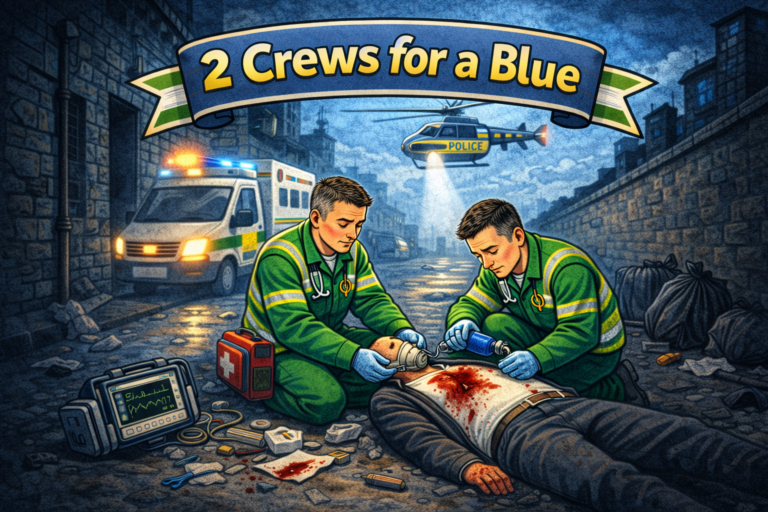
When the cutting is done at an RTC and the access is created, you step in. Sometimes the patient is already being spoken to by a firefighter who got there first and has been holding the space — talking calmly, keeping the person connected and present while the extrication happened around them. You walk into a scene and find a firefighter holding a mask to a patient’s face or maintaining manual in-line stabilisation of a head with the quiet competence of someone who has done it before. They don’t make a production of it. They do it because it needs doing and they are there and they are capable and the patient is better for it.
They are also, when the clinical work requires it, the most reliable drip stand available. This becomes a running joke on prolonged scenes — a firefighter standing beside the stretcher, arm raised, holding a bag of saline at exactly the right height, not moving, not complaining, for as long as it takes. Human equipment, deployed without ceremony and without protest. Solid. Reliable. Exactly what you need when your hands are occupied and there is nobody else available to hold the bag.
And they are good at the part of the job that has nothing to do with clinical skill or physical strength. The family standing at the edge of the scene who nobody has time to attend to properly. The bystander who has witnessed something they are not going to process easily. The person whose world has just changed and who needs a human presence before they need anything else. The fire service, without being asked, without making a fuss of it, provides that presence. Not as clinicians. As people. Steady, uniformed, capable-looking people who stand with the family while the work happens and who stay until the immediate crisis has passed enough for everyone to breathe.
That is not something that appears in any protocol. It is simply what happens when people who are good at difficult situations find the thing that needs doing and do it.
House fires bring a different dynamic again. Because in a house fire, the fire service operates in a space that is entirely theirs. They go into places we cannot go. Into heat. Into smoke. Into conditions that are actively hostile to human life. They do it wearing breathing apparatus and carrying equipment and trusting their training and each other, and they do it because it is their job, and there is a particular kind of respect that comes from watching someone walk into a building you could not enter and come back out carrying a person who would not have come out otherwise.
Our role at a house fire is to wait, to prepare, and to receive. We set up. We anticipate. We have the kit ready for whatever comes through that door. And when a firefighter brings someone out — sometimes conscious, sometimes not, sometimes in a condition that tells you immediately how difficult the next few minutes are going to be — that is where the handover happens. Not with paperwork. Not with a formal briefing. With a look, a few words, and the immediate understanding that the patient is now yours and everything that happened before that moment was theirs. They don’t step back and disappear. They stay. They assist. They hold things, carry things, do whatever is needed, because once someone is out of a burning building the job is not finished — it has only changed shape.
Over nineteen years, you stop seeing uniforms and start seeing people. You recognise individuals. You know how certain crews work. How certain officers run a scene. You develop a familiarity with specific firefighters that makes things smoother at three in the morning because you do not need to build the working relationship from scratch — it is already there, built from dozens of previous jobs, and it means that the first few minutes of a shared scene, which are often the most critical, run on trust rather than introduction. There are firefighters I worked alongside repeatedly over the years whose names I knew, whose habits I recognised, whose presence at a scene made me feel, in a way I would not have been able to articulate at the time, that the job was going to go well. That is not a small thing. In work like this, knowing who is beside you matters as much as knowing what to do.
There is a moment, at the end of a significant incident, when the work is done and the resources are standing down and the scene that has been full of activity and noise and coordinated effort begins to return to whatever it was before the calls came in. In that moment, between ambulance and fire, something passes that has no official name and requires no particular form. It might be a nod. A handshake. A hand on the shoulder. A brief exchange — a word about the job, an acknowledgement of what was difficult about it, a joke if the job allows for one.
After that incident in the early hours, standing at the edge of a scene that was winding down, it was a brief conversation and a joke about beds and finishing times and the comparative comfort of whatever was waiting for the fire crews at the end of their shift. Said with a smile. Received with a laugh. Meaning something considerably more than it appeared to on the surface.
That is what nineteen years of it looks like. Not grand or ceremonious or easily described to someone who has not stood at the edge of a difficult scene at two in the morning and felt it. Just two services who have been through things together — who have stood in difficult rooms and on difficult roadsides and in the early hours of mornings that nobody planned for — and who have come to understand each other in the way that only shared experience produces. The relationship is not written into any agreement. It is not the product of a memorandum of understanding or an inter-agency working group or a policy document with both logos on the front. It is the product of turning up, again and again, to the same kinds of jobs, in the same kinds of conditions, and finding that the people standing next to you in different uniforms are doing the same thing you are doing, for the same reasons, and doing it well.
You do not talk about that in those terms on the night. You talk about it in slagging and in tea and in the brief nod across a car park when the scene is winding down. But it is there. It has always been there. And it will be there long after any of us who are in the job now have hung up our uniforms and left it to the next lot, who will discover it for themselves the same way we did — by turning up, and finding the water babies already there.
The water babies can have their beds and their gyms and their tabards and their command structure. They have earned the slagging and they know it and they give as good as they get, which is as it should be. Behind all of it — behind every joke about cutting things up and every observation about sleeping on duty and every carefully counted tabard at every major incident — is something that neither service would necessarily say out loud but that both of us know.
When it matters, it works. Because they show up. Beds or no beds, tabards beyond counting. And when it is over, a nod is enough. It always has been.