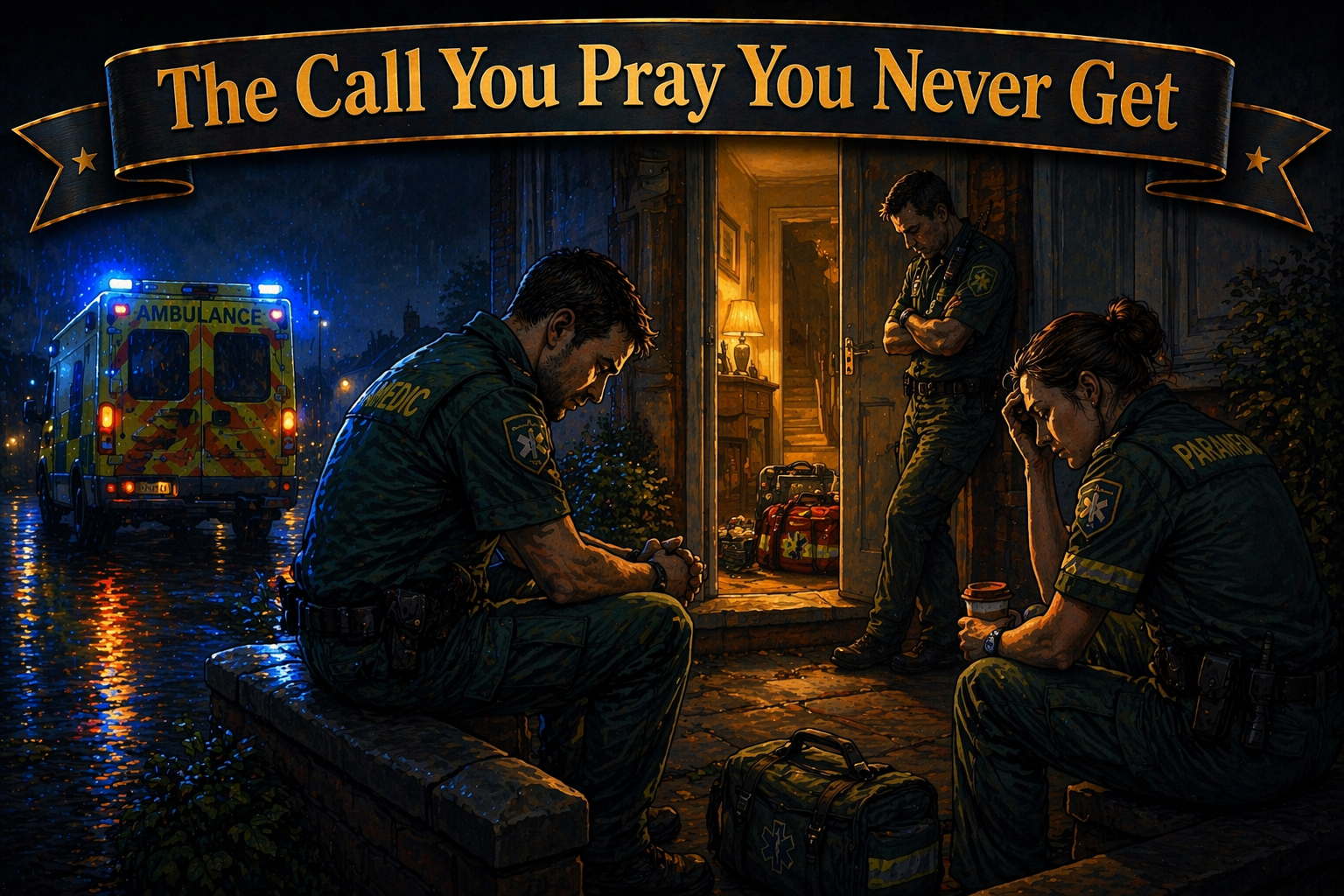
This story first appeared on my Facebook page in 2016. I wrote it the morning after, still in the middle of it. Returning to it years later gave me the distance to write it the way it deserved.
For those who have read it before, it is the same call. It is a different piece of writing.
Years ago, in a room that smelled of instant coffee and carpet cleaner, a group of us learned how to handle the medical emergencies we would encounter on the job. The training was practical, and the practical tests had a particular luxury to them that the job itself never would.
If a scenario went wrong — if you fumbled a drug dose, if you forgot a step, if the mannequin on the floor refused to come back under your hands — you could stand up, walk out of the room, take a breath in the corridor, and come back in to start again. The instructor would reset the scene. The clock would reset. Nobody had actually died. One of the trainers told us, early on, that there would be a call one day that we would never forget. He said it without drama. He said it the way a mechanic tells an apprentice that eventually they will strip a thread. He said, “You will get the call you never, ever want. There will be a time when you cry over what has just happened. Never be ashamed of that. If that is what is needed, then do it.”
I remember nodding along with the rest of them, the way you nod at advice that belongs, in your head, to someone else’s future. You never forget your first call of various circumstances, and you carry, from the beginning, a list of the calls you pray you never get. Every EMT and paramedic has that list. It is unwritten, and it is personal, and it gets shorter only in the sense that the calls on it, one by one, stop being theoretical. My luck ran out on a shift that started like any other.
I had made a cup of tea. I had checked the vehicle. I had laughed at something in the station kitchen that I cannot now remember. And then the details flashed up on the MDT, and I started to pray. I prayed in the way people in the job pray, which is to say not in any religious sense, but in a bargaining sense. I prayed the details were wrong. I prayed they would change en route. I prayed the address would not be hard to find, and then, ashamed of praying that, I prayed it would be easy. I prayed the cars in front of me would see the blue lights sooner. I prayed for the junction to be clear. I prayed, underneath all of it, for the call to be something other than what the screen said it was.
On the way to a job like that, your mind runs in several directions at once, and none of them is where you want them to be. Part of you is on the road, tracking the cars, reading the junctions, managing the speed. Part of you is in the back of the ambulance in your head, rehearsing. Which bag, which drug, which dose for the weight you’re expecting? Your crewmate in the passenger seat is doing the same thing silently, thumb moving down a page of the drug book, lips moving without sound. Neither of you talks much. There is nothing useful to say. You know it is bad when you arrive at the door, and you can hear the screams from inside the cab. The windows of an ambulance are shut and reinforced, built for your protection, and still the screams come through. They are not screams of anger or fear. They are the other kind. The kind that comes from a part of a human being most people never have cause to access, a sound that belongs to primal loss, and it sets the hair on the back of your neck up before your conscious mind has caught up with what you are hearing.
You move fast. You throw the doors of the ambulance open and grab the kit, hoping you will not need most of it, while your crewmate is already past you and moving towards the house. There is no conversation about who carries what. There never is. You have worked together long enough that the division of labour is muscle memory. You do not make eye contact with the family in the living room. That is not coldness. That is a discipline. If you look at them now, you will carry their faces into the next room with you, and the next room is where you need to be clean. You keep your eyes on the hallway, on the door frame, on the bag in your hand, and you follow the sound.
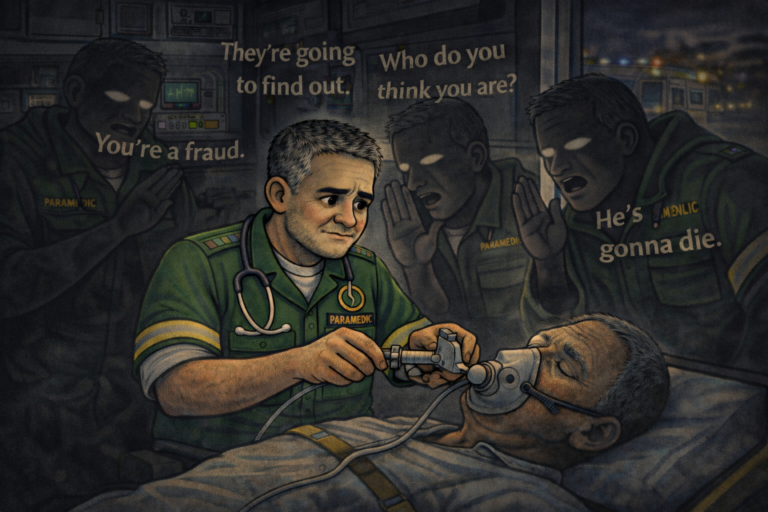
Nothing prepares you for what is in the room. Nothing can. All the training, all the scenarios, all the practice on mannequins in bright classrooms — none of it produces the moment you are standing in now. You go down onto your knees, and you start. You and your mate work in tandem. You know what they are doing. They know what you need. You do not speak in full sentences. You speak in half-words, numbers, and acknowledgements. The room shrinks down to the size of the patient in front of you. The family is somewhere at the edge of your hearing, moving in and out of the doorway, and you register them without looking at them. They are saying the things families say. Don’t go. Stay with us. We love you. We are here. There is a phrase instructors sometimes use. Think outside the box. In a room like this one, the box is too big to think outside of. You are already doing everything the box contains. The question is whether the box is going to be enough, and you know, a long way before you admit it, that it might not be.
Extra crews arrive. More hands. More kit. People moving in and out of the front door of the house, with the blue lights still turning on in the street outside. Somebody is keeping the family back. Somebody is running to the ambulance and back for a piece of equipment. The living room, on the other side of the wall, has become a gathered grief you can hear without seeing. Everyone in the room agrees, without saying it outright, that we need to move. We agree on a plan. We try to hold onto the patient’s dignity and the family’s dignity at the same time, which is its own small discipline. People are asked to move. Furniture is asked to be moved. Everyone has a role in the lift.
The kit goes out first. The patient goes next. You go past the packed living room without looking into it, and past the faces that are looking at you for something your face cannot give them, and into the street. Nothing brings neighbours out of their houses like blue lights in the road. There is a small crowd by the time we load. You feel their eyes on your back, and you ignore them, and you close the doors. In the back of a moving ambulance, at speed, you do not stand. Standing is not safe, and it is not steady enough for the work. I am on my hands and knees on the floor of the saloon, doing what I need to do, bracing against the turns with whatever part of me is free to brace. Inside my head, beneath the clinical voice calling the next action, another voice is saying, over and over, please, please, give me something. My two colleagues in the back are doing the same. None of us says it out loud. All of us hear it.
The ambulance screeches to a halt at the hospital. The back doors are flung open from the outside, and there is the team, waiting. Doctors. Nurses. Specialists. Every one of them is ready. The patient, the crew, and the kit all move together into the room nobody likes to go into, the one at the end of the corridor with the hard lights and the empty trolley waiting. They take over. We hang at the edge. Questions are asked. Answers are provided where available. You stay close, in case someone needs another piece of information, an extra pair of hands, or anything else you can contribute. For a while, there is. Then there isn’t, and you step back, and you step outside. The family has arrived. They are in the corridor now, and more of them are coming through the main doors every minute. They look at me the way people look at anyone in uniform when the person they love is behind a closed door. I have nothing I can give them that would be honest and also kind. I say the only sentence available. They are with the doctors now. One of them will be with you shortly. I pass the buck, because passing the buck is the only thing in this moment that does not risk making the next hour worse for them.
Outside, there is rain. Not heavy. The kind of soft, unhurried rain that is always falling somewhere in this country. I stand in it for a moment without moving. The cold air on my face is the first thing that has belonged to me, rather than to the call, in what feels like a very long time. Then my mind, which I had managed to pin to the problem for the length of the job, comes unpinned, and the questions start. Did I miss anything? Was there a second between the door and the room where I could have moved faster? Was the dose right? Was the timing right? Should I have tried the other thing? The trainer who said you would get the call you never want did not tell us that the hardest part of the call comes after you have stopped working, in the seconds when your hands are suddenly empty, and there is nothing to do with them.
More families are running towards the hospital doors as I stand there. They look at me as they pass, and I look past them, because I have nothing for them yet, and they deserve better than my face. And then the screams start again, inside the building this time, and harsher than before. You do not need to ask about the outcome. You stand in the rain, and you know. I grab the tissue out of my pocket, and I cry as quietly as I can manage, turned slightly away from the building so no member of the family who steps out for air will see it. My colleagues are a few feet off, talking in the low tones people in this job use at these moments. Nobody comes over. Nobody needs to. The distance is itself a kindness. You stand in the cold, and you think about everyone this call has touched, and how far out the rings of it go.
You think about the call taker in ambulance control who had to listen to those screams down the phone and keep her voice steady while she gave instructions she knew were not going to be enough. You think about the family, who will spend the rest of their lives asking the questions I have just been asking about myself, and who will not always get better answers than I am getting. You think about the friends who have not yet been told, who are still living in the version of their day where the person is alive. You think about the nurses and doctors behind the door, who took the patient from us and are about to have the conversation with the family that nobody in any uniform ever wants to have. You think about the neighbours in the street who saw the blue lights and will know by tomorrow. The shape of what has happened extends far beyond the room where it happened.
The doctors call us back in after a while. They explain what happened and thank us for what we did. They tell us, in the careful language they use at these moments, that what we did was more than they had expected, and that the outcome would have been the same in any hands. We acknowledge it. We say the right things back. Deep down, under the thanks, there is the knowledge that this is what we do every day, and that the thanks, however kindly meant, cannot do anything about the room we left behind. We head back to the station. None of us talks much in the cab. Heads are all over the place.
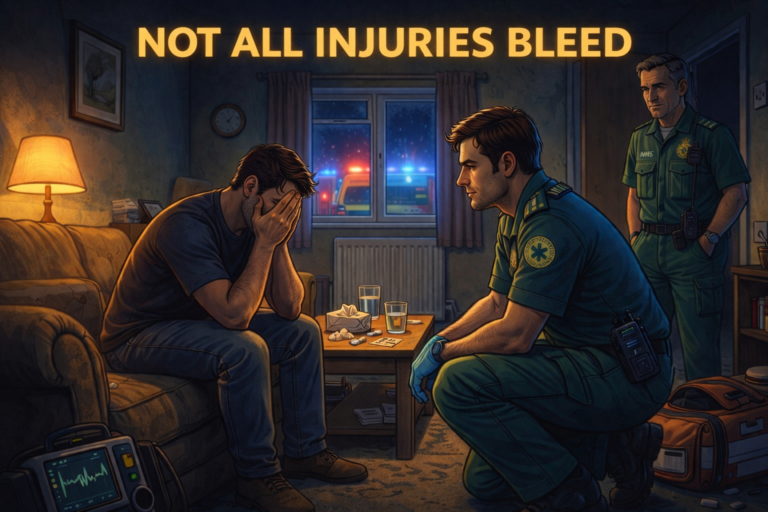
When we get in, colleagues who have had their own versions of this call over the years start to come through the door, one at a time, without making a fuss. You don’t have to explain to them. They know by looking. They have had their own. They tell you, in the way crews tell each other these things, that they have felt what you are feeling. Hugs don’t need to be asked for. They are just given. The teapot goes on. The talking begins. I know, sitting there with the mug in my hands, that I am not in the right frame of mind to continue my shift. The officer knows. The other crews know. They tell me to go home. They mean it. And still the guilt arrives, right on cue, because that is what guilt does in this job. Guilt for leaving colleagues short. Guilt for not being harder than I am. Guilt for the fact that other members of staff have had calls like this one and have gone back out on the road an hour later and finished the shift.
You question, quietly, whether you have the strength for the job you have chosen. You know, quietly, that this question is not a useful one to ask tonight, and you ask it anyway. On the drive home, the roller coaster starts again. I do not like the silence in the car, because in the silence, the screams come back. I do not like the radio either, because the idea of singing along to something is unbearable. I drive with neither, and I arrive home without remembering most of the road. Inside the house, there is the small, ordinary question of what to do with yourself. Do you pour a beer and hope it helps you sleep? Do you go straight upstairs? Do you eat something because you have not eaten in many hours, or is the idea of food impossible? I do not remember what I chose. What I remember is getting into bed and holding my wife, and her knowing, because she had been told by another colleague who had heard it being played out over the radio. She asks if I am okay because she knows that there’s nothing she can say. Sleep is hard to find, even when you are as tired as this, in both of the ways a person can be tired. You close your eyes, and you are back in the room with the patient in front of you.
The whole thing plays again, from the details on the screen to the rain outside the hospital, and the only way to stop it is to open your eyes. You dose. You jerk awake. You already know why. The room is dark, and you lie in it, and you watch the window go from black to grey to the pale, unbothered light of another morning, and the clock changes from night to day while you are still inside the night.
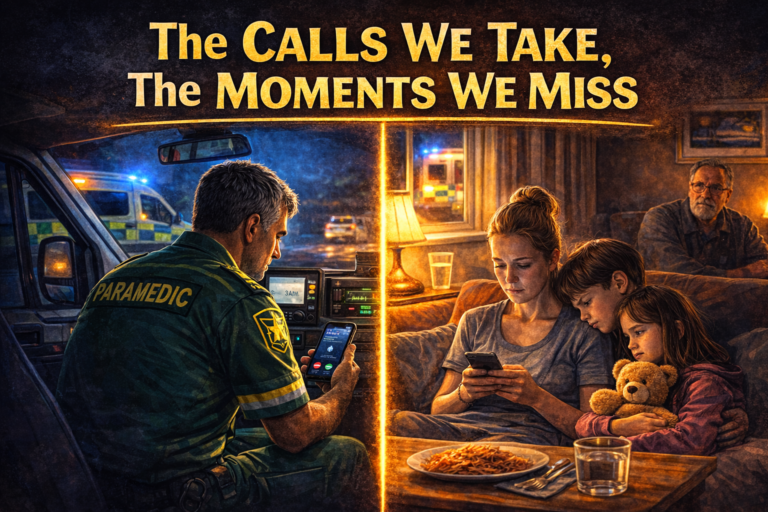
I wrote this down the day after the call, because if I hadn’t, I am not sure I would have found the words later. Some people who see this will wonder why I am putting it on the internet at all. I have my reasons. One of them is that the following night, the uniform was back on, and I would be back in the ambulance, doing the job I trained to do, to the best of my ability. To the colleagues on shift with me that night, if I was not my usual chatty self, I was not sulking or moody. I was doing my best to get on with the job in hand, and I appreciated your understanding of what I have been through.
The other reason was for the people who are not in this job, and who form most of their picture of it from television. What we do is not like the TV programme Casualty. We did not have the luxury of a reset. We did not get to stand up, walk out of the room, breathe in the corridor and come back in to start the scenario again. When a call goes the way this one went, there is no instructor to pause the clock. There is only what we did, and what we did not do, and the room, and the family, and the drive home. That was the call the trainer warned us about, all those years ago. The one you never, ever want. I now understand why he said it without drama. Drama was not the point.
He was handing us information we would not be able to use until the day we needed it, and he was telling us, in advance, that on that day, we would be allowed to cry. I did not know, sitting in that classroom, how much that small permission would matter. My thanks, at the end of this, to the people who showed me understanding in the hours and days after.
To my colleagues, who put the kettle on without asking. To the crews who covered the rest of my shift and told me not to feel bad about it, even though I always would. And most of all, to my wife, Claire, who understood exactly how I felt and made an episode that was never going to be easy far easier to deal with than it otherwise would have been. It was my first call of that kind. It was not my last. But it is the one I will never, ever forget, and I put it down here, in full, so that the next time somebody in this job has their own version of that shift, they will know, reading this, that they are not on their own in what comes afterwards.
The crying is allowed. The guilt is normal. The sleepless morning is part of it. And the uniform, when the time comes, went back on.