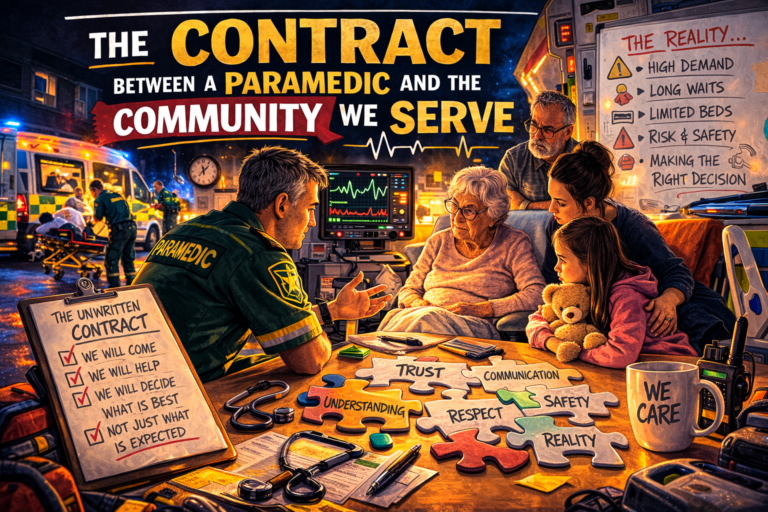
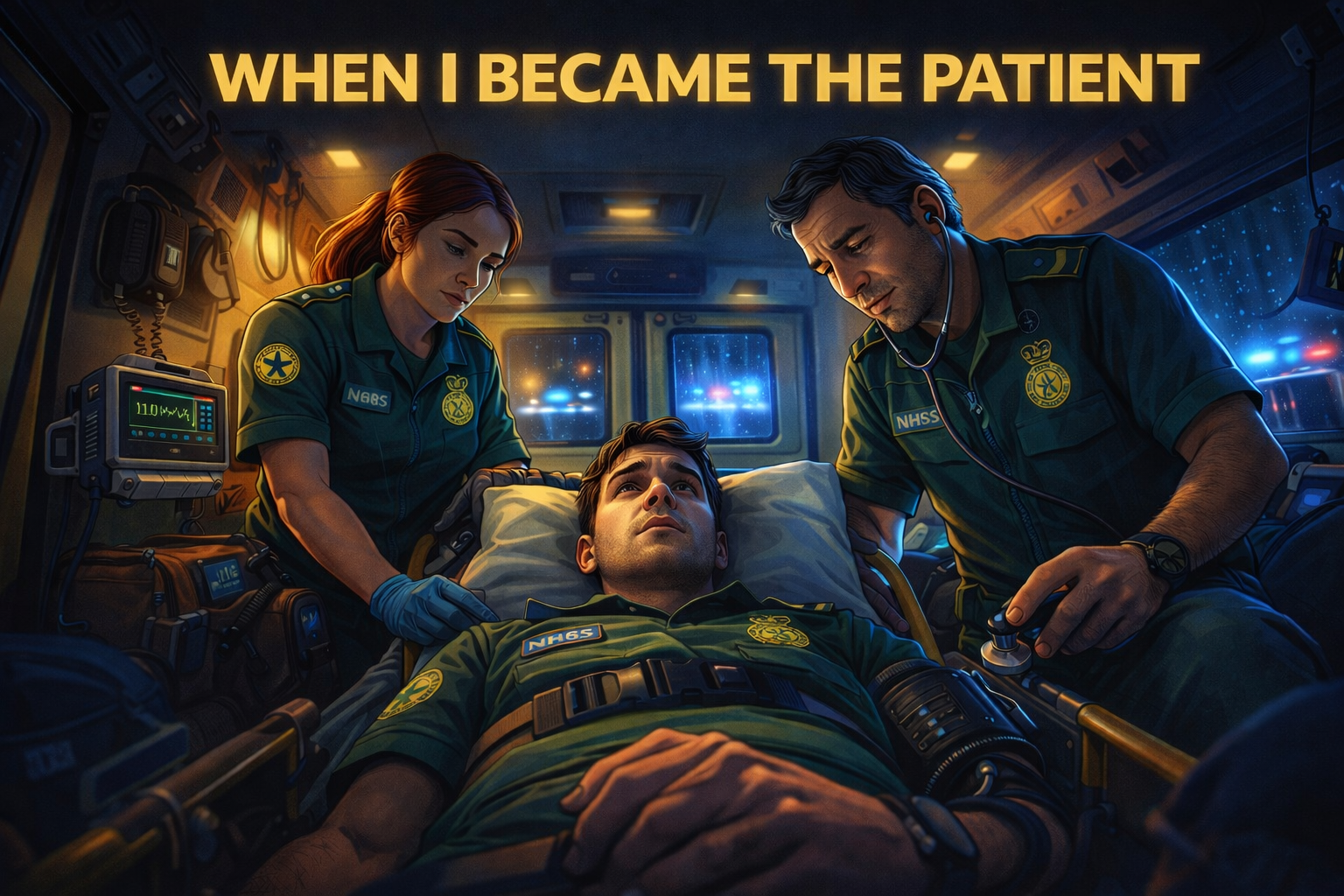
You spend years learning how to read a room in seconds. Not the walls. Not the furniture. The people. The silence. The things that aren’t being said.
You learn to walk in with purpose. To take control without asking permission. To scan, assess, prioritise, and act. You learn where to stand, what to touch, and what to ignore. You learn how to speak in a tone that reassures without lying, and how to make decisions that carry weight long after the job is over. You learn that your presence alone — the uniform, the bag, the way you move — changes the atmosphere the moment you cross the threshold. People reorganise themselves around you. They hand you responsibility without discussion, and you carry it without thinking, because after enough years, it stops feeling like something you choose to do and starts feeling like something you are. You learn how to be a Paramedic or an EMT. What nobody prepares you for is the moment you stop being that person.
It doesn’t happen with ceremony. There’s no handover, no formal transfer of role. It happens quietly. Subtly at first. Then all at once. One moment, you are the person who arrives. Next, you are the person who called, and between those two versions of yourself, there is a gap that nothing in your training ever prepares you to cross.
You notice it first in the loss of control. As a Paramedic or an EMT, control is everything. Even in chaos, you are taught to create structure. Algorithms layered over instinct. A mental framework that holds everything together when everything else is falling apart. It becomes automatic. It becomes the way you think, the way you walk into rooms, the way you process the world around you. That framework is not arrogance. It is what allows you to function in environments that would overwhelm most people, and after enough years, you forget it is even there. It simply becomes how you operate, but when you’re the patient, that framework no longer belongs to you.
You’re not thinking, “This is likely X or Y based on how I’m feeling.” You’re thinking, “What’s wrong with me?” and that question hits differently when it’s you. There’s a vulnerability in that moment that cuts through years of training. The clinical voice is still there, trying to categorise and stay objective, but it’s quieter now because another voice has taken its place. The human one.
The one who doesn’t think in terms of guidelines or pathways, but in terms of consequences. In the family. In “what if.” You realise very quickly that knowledge doesn’t insulate you from fear. If anything, it sharpens it. You know too much. You know what certain symptoms can mean. You know the outliers. The rare but real scenarios that sit at the back of your mind when you’re treating others, but rarely say out loud. You’ve seen how quickly things can change, and now that knowledge is pointed inward, it is not the comfort you might have expected.
You try to assess yourself the way you would assess anyone else. If you have pain, you ask about the Onset. Provocation. Quality. Radiation. Severity and Time, but it feels forced. Detached. Like reading from a script that doesn’t quite fit the moment because you can’t step outside yourself, you can’t gain the distance you rely on as a clinician. You are simultaneously the most informed person in the room and the least able to act on it, and that combination is more unsettling than anything you would have predicted. There is also something else that surprises you.
The embarrassment. You of all people should not be here, needing help, unable to manage whatever this is. You have walked into rooms where people were frightened and taken charge. You have been the calm in the middle of other people’s worst moments, and now here you are, in your own worst moment, and the calm that you carry so reliably into other people’s homes has quietly abandoned you. That realisation — that the skills and the training and the years of experience do not make you immune — sits with you in a way that is difficult to name but impossible to ignore. Then the crew arrives.
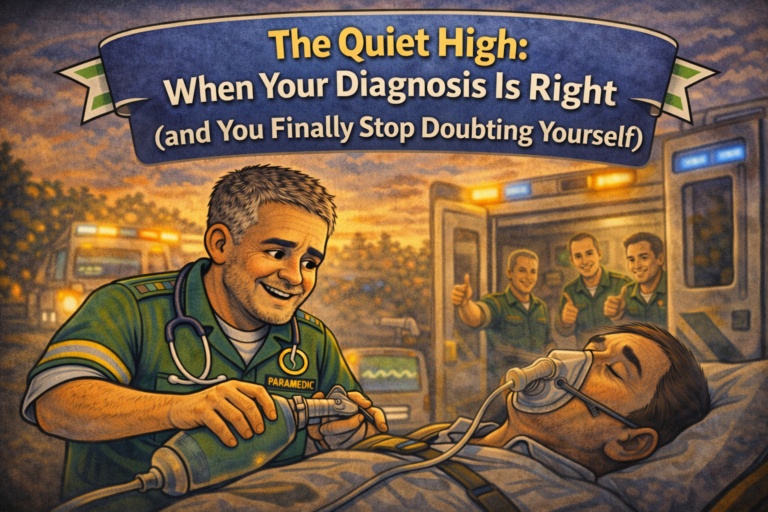
You hear the vehicle before you see it. The sound is familiar. A sound you’ve been part of for years. A sound that usually means you’re about to take over. This time, it means something else. They walk in the same way you do. You know their names, which station they are from, and what’s coming next. Controlled. Observant. Professional. You see yourself in them, in the way their eyes move across the room before they’ve said a word. You know the choreography. You know what they’re doing before they do it, because you have done it yourself more times than you can count. Then one of them looks at you — not as a colleague, not as someone who understands the job — but as the patient. That’s the moment it lands.
You are no longer part of the team. You are the job. You are the patient.
There’s an instinct to help. To say, “I think it’s this,” or “My obs were…” but you hesitate. You’ve been on the other side of it. You know how that sounds. So you choose your words carefully. You offer what’s useful and hold back what isn’t. You try to be the patient they need rather than the clinician you’re used to being, and the effort that takes surprises you. Stepping out of a role you’ve inhabited for years, even when you know it’s right, takes more than you’d expect, and in that restraint, something else emerges.
Trust.
Not the abstract concept of professional confidence. Real trust. The kind that requires you to let go completely. To allow someone else to take over your care. It sounds simple. It isn’t. You’re used to being the one people look to. Now you’re the one waiting. Waiting for questions and waiting for reassurance. Waiting for answers you can’t provide for yourself, and the waiting has a texture you never appreciated from the other side. It is not passive. It is its own kind of effort — holding yourself still, allowing someone else to lead, resisting the pull toward the role that feels natural.
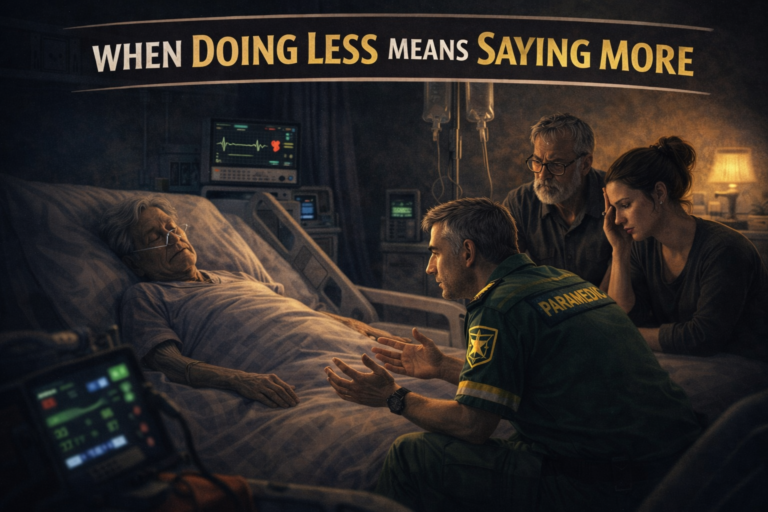
You notice things you never noticed before. The tone of voice. The pacing of questions. The glances between crew members. The slight hesitation before an answer. Small things you would never have registered when you were the one asking. Now they land. A calm explanation anchors you. A moment of eye contact steadies you in a way no piece of equipment ever could, and the absence of those things is just as powerful. A rushed question. A clipped response. They don’t just affect your understanding. They affect your sense of safety. You begin to understand something no guideline ever fully captures. Being a patient is not just a clinical experience. It’s an emotional one, and those two things are inseparable.
You’re moved onto the ambulance, feeling the bumps of the ground and the tail lift. You hear the words everyone who works on an ambulance says, “You’re going to feel a wee bump”. Then you’re in the back. You’ve spent years working in that space. You know every inch of it. Now you’re lying in it, looking up instead of down, and the perspective is completely different. The ceiling feels closer. The space feels smaller. Every turn, every stop, every acceleration is something you feel rather than manage. You hear the radio differently — not as information to process but as something distant, fragmented, just out of reach. The environment that has always meant work, purpose, forward motion, now means something else entirely. It means waiting. It means being carried rather than driving, and that shift in what the space represents is stranger than you might imagine.
A sentence like “We’re about ten minutes away” carries more weight than you would have thought because it gives you something to hold onto. Time becomes important in a way it never is on the job. Not measured against targets or clinical windows, but personally. How long until someone knows what’s wrong? How long until this feeling changes? How long until you are back on the other side of it? The questions are different. We can’t always give clear answers.
At the hospital, you’re handed over. You’ve done hundreds of handovers. Again, you know the staff and their names. You know the structure. Now you’re listening to your own story being told by someone else. Condensed. Structured. Clinical. Accurate but not complete. It doesn’t capture the uncertainty, the internal dialogue, the fear sitting just below the surface. It’s not meant to. Clinical communication is designed for efficiency. Human experience isn’t, and the gap between those two things — the gap you are lying in the middle of — is wider than you ever appreciated from the other side.
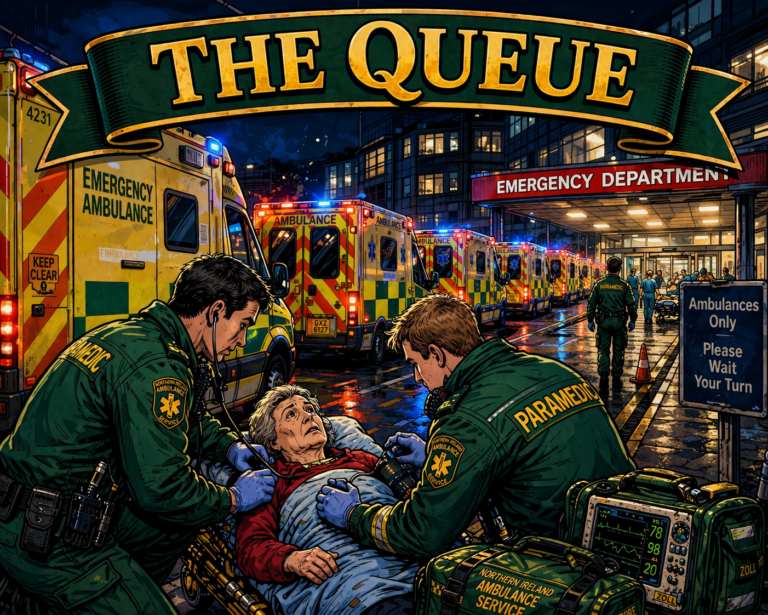
You become part of the system you’ve been delivering into for years, and you see it differently. The waiting. The prioritisation. You’ve justified delays to patients more times than you can count. Now you’re the one waiting, and even with everything you know, even with your understanding of why it works the way it does, it still feels different from inside it because understanding doesn’t eliminate the experience. You sit with that. The strange duality of knowing the system completely and still feeling uncertain within it, and not being able to resolve it. It simply has to be lived through.
Something shifts. Not dramatically. Quietly. You begin to carry both roles at once—the paramedic and the patient. Everything you’ve done in your career has been filtered through one side of that experience. Now you’ve seen the other, and it doesn’t leave you. It doesn’t become a lesson you consciously apply or a framework you run through at the start of each job. It sits in the background. In the way you speak. In the way you explain things. In the way you pause, just slightly longer than you used to, in the moments where a patient looks uncertain, and you recognise exactly what that uncertainty feels like from the inside.
Then, when you’re better, you go back to work and put on the uniform. You pick up the radio. On the surface, everything is the same. The calls still come in. The framework is still there, but something is different. Subtle, but real. You don’t rush the explanation as much. You don’t fill silence unnecessarily. You allow space because you know what that space feels like from the other side. You know what it means to be lying on a stretcher, hoping that the person looking after you will take a moment to explain what is happening, and knowing it from the inside changes how deliberately you offer it from the outside.
There’s a job, not long after, where it becomes clear. An anxious patient. Not critically unwell. Not unstable. Just unsettled and frightened and trying to hold it together in front of strangers in a moment they didn’t plan for. You recognise it immediately because you’ve felt it. Instead of moving to the next question, the next step, you pause, just for a second. You explain what you’re doing and why. You give them a sense of what comes next, and you see it — that slight shift. The easing. The moment where uncertainty becomes something more manageable. It’s a small thing, but you know exactly what it means to be on the receiving end of it, and that knowledge changes how deliberately you offer it.
Being a paramedic teaches you how to care for people. Being a patient teaches you what care feels like.
Somewhere between those two experiences is where real practice lives. Not just in the interventions or the decisions. In connection. In the understanding that for every person you treat, this is not routine. This is their moment. Their fear. Their loss of control, and for a brief period, you are the most important presence in it. Not because of what you do, but because of how you show up. Becoming the patient doesn’t diminish the job.
It deepens it. It strips away assumptions. It reminds you that knowledge alone was never enough, and that the person on the floor, or the chair, or the stretcher isn’t simply presenting with a condition. They are handing something over to you. Something significant and how you hold that — how carefully, how honestly, how humanly — is the part of this job that no exam ever tested and no protocol ever captured.
Once you’ve been on the other side of the stretcher, you never quite see it the same way again, and you wouldn’t want to.