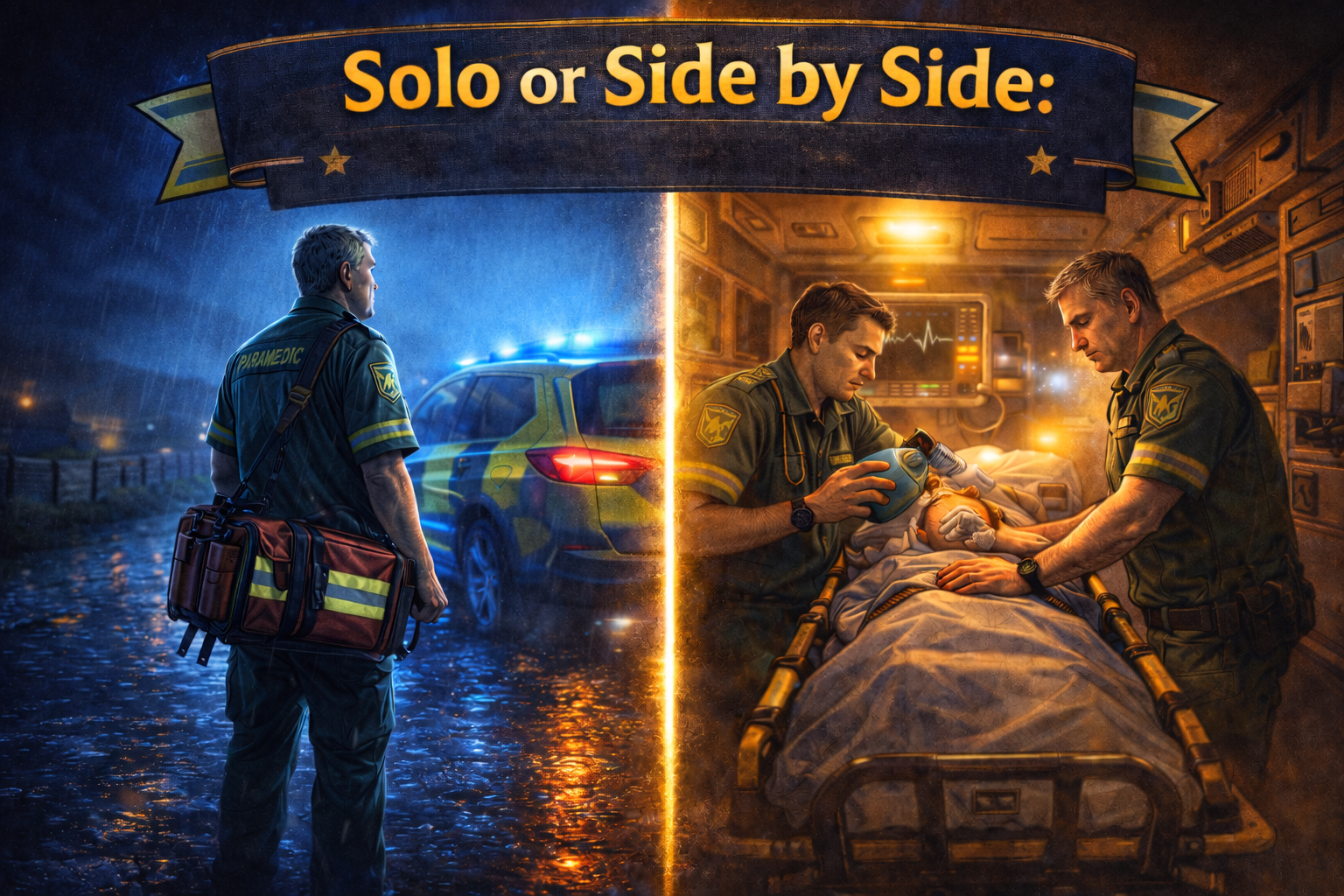
Ambulance work looks simple from the outside. Two people arrive in an ambulance, one speaks, one drives, and a patient gets lifted, treated, and transported. That’s the public picture—tidy, logical, like a well-rehearsed routine. Still, anyone who’s spent time in the service knows that picture is missing the part that actually keeps everything together. The job isn’t two people sharing a vehicle. It’s two people sharing a brain under pressure. It’s a partnership that has to function in cramped spaces, chaotic homes, dangerous environments, and emotionally charged situations—often with very little information, very little time, and absolutely no guarantee that the job will go the way the training scenarios said it would.
That partnership is the quiet engine room of pre-hospital care. It’s not glamorous, and it doesn’t show up in TV dramas, but it’s what makes the job safe. It’s what makes the job sustainable, and when it’s missing—or when it’s weak—you feel it immediately. The truth is, most of what keeps you afloat in this work isn’t the big clinical interventions people imagine. It’s the everyday coordination between you and the person beside you. The shared understanding. The non-verbal communication. The ability to divide tasks without dividing the room. The willingness to back each other up and, above all, the trust that the other person will do what needs to be done when everything is moving too fast to discuss.
Ambulance work is not just stressful in bursts. It is pressure as a default setting—the call stack. The radio keeps talking. The system doesn’t pause to let you catch your breath. The public’s expectations don’t reduce because you missed your break. The patient’s illness doesn’t care if you’re on your fourth job in a row and under constant pressure; you bring one of the most important variables in your working day: your crewmate.
If you’re a relief member of staff, you don’t choose your partner the way you choose a friend. You get paired. Sometimes you get lucky, and you land with someone whose style complements yours, someone who makes the shift feel smoother, calmer, safer. Sometimes you get rotated with different people for every shift. Sometimes you work with someone you’ve known for years. Sometimes you sit in the cab with someone you’ve never met, trying to figure out in the first ten minutes whether they’re competent, calm, and safe—or whether you’re going to spend twelve hours doing the job while also managing the discomfort of a partnership that doesn’t fit.
If you are a core member of staff, you have a regular crewmate that you work with every shift until you retire, move stations, or your crewmate does the same, and this is where people outside the service often misunderstand the dynamic. They assume it’s a fixed hierarchy. One “in charge”, one “assisting.” They assume the senior clinician leads and the other follows. Sometimes, on paper, that’s true, but the best crews don’t run on hierarchy. They run on a partnership because in this work, a rigid hierarchy can slow you down. It can make people passive. It can stop someone from speaking up when something feels wrong, and silence is one of the most dangerous things you can have on a scene.
The best crews operate like a two-person system, not a two-person ladder. You each have roles, strengths, and responsibilities. The more senior clinician might take the lead on certain decisions, but a good partner doesn’t become a passenger. A good partner contributes, anticipates, catches, supports, and sometimes quietly steers you away from a mistake before it happens. That’s real trust: the kind that protects patients without bruising anyone’s ego.
Trust in this job isn’t sentimental. It’s operational. Trust means you know your partner checked the vehicle properly without being asked. Trust means you know they won’t turn up with missing oxygen because they “thought it would be fine.” Trust means you know their driving will be safe but assertive—no heroics, no hesitations, just competent movement. Trust means you know that when you walk into a house, and your attention narrows to the patient, they’ll be scanning the environment: hazards, exits, people, mood shifts, the relative who’s getting louder, the dog who looks like it’s one insult away from biting, the broken step that could take you both down. Trust means you know that if you miss something, they’ll catch it, and they’ll do it quietly. Not as a performance. Not as a point-scoring exercise. Just as good teamwork.
That trust isn’t automatically granted because you share a uniform. It’s built. Sometimes in weeks. Sometimes in one job. Sometimes never. Pressure is the environment in which trust forms. Pressure reveals how people really operate. When things get busy—when you’re tired, when you’ve missed meals, when the hospital queue is brutal, when the calls are heavy—the mask slips. You see who people are when they don’t have the energy to pretend. Do they become sharper? Do they become calmer? Do they get irritable? Do they shut down? Do they stay focused? Do they panic? The job doesn’t care about your personality. It will stress-test it anyway, and the stress-test isn’t only clinical.
A lot of the pressure in ambulance work is social. You’re often walking into someone’s home at the worst moment of their life. There’s emotion everywhere. Fear. Anger. grief. confusion. A good partner helps you manage that emotional climate. They know when to talk, when to stay quiet, when to reassure, and when to be firm. They can read the room. They can sense when the temperature is rising. They can step in and take over the conversation with a difficult relative when you need to focus on the patient. They can smooth things out before they turn into conflict.
That social work is invisible yet central. Ambulance crews don’t operate in controlled hospital bays most of the time. We operate in living rooms, stairwells, streets, cars, and fields. We operate in environments where a patient’s presentation is shaped by their context: their family, their housing, their fear, their history. That’s why two jobs with identical symptoms can be completely different experiences. The context changes everything. A good partnership adapts quickly to context. You don’t need to have a long discussion about who does what. You do it. One person gets vitals. The other starts history. One person prepares the kit. The other manages the family.
One person controls the scene. The other controls the patient care. Roles can swap fluidly depending on what’s needed. It’s like a dance, but one where the music keeps changing tempo, and the dance floor sometimes turns out to be a cramped landing with a bannister digging into your ribs.
The best partnerships often involve very little talking. Not because you don’t get along, but because you don’t need to narrate. You know what your partner is doing. You can hand something without asking. You can make eye contact and convey ‘This is serious’ without saying a word. You can feel when they’re about to step forward and when they need you to step forward. That level of coordination doesn’t happen instantly. It grows with shared experience. But once you’ve had it, you realise how powerful it is.
The flip side is how exhausting it is when you don’t have it.
Working with someone you don’t trust means you’re doing two jobs. You’re treating the patient and managing your partner. You’re double-checking kit, double-checking decisions, double-checking tasks. You’re watching for errors. You’re trying to correct without humiliating. You’re managing tension while trying to appear calm to the patient. That drains you faster than any busy shift. It’s cognitive load on top of cognitive load, and in a job that already requires constant awareness, it can push you closer to burnout without you even realising. Pressure also exposes the ego, and ego is poison in this kind of work.
A clinician who needs to be right all the time is dangerous. A clinician who can’t take correction is dangerous. A clinician who treats the job like a stage is dangerous. The patient doesn’t need performance; they need teamwork, and the best partnerships are built on humility. The ability to say, “I’m not sure,” or “What do you think?” without feeling like it undermines authority. In fact, it often strengthens it. Shared decision-making is safer decision-making because it reduces blind spots.
That’s why some of the best crew dynamics happen between clinicians with different strengths. One might be brilliant at scene control and communication. The other might be brilliant at clinical assessment and detail. One might have a calm presence that settles a room. The other might have sharp pattern recognition. Together, they become more than the sum of their parts. That’s partnership at its best: complementary strengths, shared responsibility, mutual respect.
Now, another side of this conversation has become more common in modern ambulance services: the solo responder working on the Rapid Response Vehicle, the RRV. The single clinician, arriving alone in a car with blue lights and a boot full of kit, stepping into situations that can be unpredictable, emotionally heavy, and sometimes physically challenging, without a partner beside them.
To outsiders, the RRV can look like the ultimate paramedic fantasy: autonomy, speed, independence. You arrive quickly. You assess quickly. You treat quickly. You make decisions without anyone looking over your shoulder. You decide what happens next by selecting the appropriate form of transport and the care pathway the patient needs. You can feel like a one-person emergency department on wheels. There is something satisfying about that. There’s a professional pride in being trusted to operate alone. There’s a confidence that comes with it.
There’s also a practical benefit: RRVs can reach patients faster in certain conditions, navigate traffic more easily, reach rural areas more quickly, and start treatment early while an ambulance is en route. From a system perspective, RRVs make sense. They allow early assessment and intervention. They can triage calls, reduce unnecessary ambulance transports, and provide rapid clinical decision-making. On paper, they are efficient. They are coverage. They are a way to put a clinician in front of the patient quickly, which is often what matters most and in some jobs, being solo is absolutely fine.
In fact, it can be ideal. You can walk in, do an assessment, and the patient doesn’t need transport. They need advice, referral, reassurance, or a simple intervention. You can leave them safely, and the system hasn’t tied up a full ambulance crew. You can clear quickly and be available again. In those moments, the RRV feels like a smart solution, but it also introduces concerns that only become obvious once you’ve worked on it.
Because being alone changes everything.
When you’re solo, you lose the second set of eyes. You lose the quiet safety net of someone watching the environment while you focus on the patient. You lose the immediate backup of someone who can fetch kit, call for help, manage relatives, or physically assist when things need to be moved. You lose the shared brain, and in a job that depends so much on partnership, that loss is significant. Solo responding demands a different kind of awareness. Your risk assessment becomes sharper because you’re the only one doing it.
You arrive at the door, and you’re thinking not just clinically but operationally: is this safe? What’s the mood? Who’s here? What’s the exit? Is there aggression? Is there intoxication? Are there weapons? Is there a dog? Is there a crowd? Is there a cramped stairwell? Is there a patient on the floor that I can’t lift? Is there a vulnerable situation where I need support?
You have to think ahead more, because you have fewer options once you’re committed inside. You also have to manage your own cognitive load differently. When you’re on an ambulance crew, you can delegate tasks: one person takes vitals, the other takes history; one sets up oxygen, the other gets access; one does the paperwork, the other reassures the family. Solo, you’re doing everything. You are a clinician, communicator, scene manager, kit carrier, note taker, and sometimes even your own security. That’s not dramatic language—it’s just reality.
The pressure feels different. In a crew, pressure is shared. In a solo car, pressure is concentrated. You can’t turn to your partner and say, “What do you think?” without making a phone call. You can’t quietly compare impressions. You can’t get that immediate second opinion that sometimes makes the difference between confidence and doubt. You have to trust your own judgement entirely, and that can be both empowering and stressful.
The RRV also changes your relationship with the patient. When you arrive alone, the patient can focus on you. There’s no crew dynamic. There’s no second uniform in the room. Sometimes that makes rapport easier. It can feel more personal, more controlled, but it can also make you more vulnerable. If a patient is агgressive or unpredictable, you are alone with them. If a scene becomes unsafe, you have to manage your exit on your own. That’s why solo responders become very skilled at reading people quickly. It’s a survival skill as much as a clinical one.
Then there’s the practical reality of movement. Ambulance work is physical. Even on “medical” calls, you might need to help someone off the floor, assist with stairs, manage a carry chair, move equipment, lift bags, or move furniture. Solo, your physical capacity is limited. You can’t safely lift someone alone. You can’t do complicated extrications alone. You can’t manage certain situations without support. That means you have to be comfortable asking for help early. There’s no shame in it. In fact, it’s good practice, but it can be frustrating when you want to complete the job only to have to wait for an ambulance crew to arrive so you can actually move the patient.
That waiting introduces another pressure: time. When you’re solo on scene, and you decide you need transport, you’re now depending on another resource. If the system is busy, that resource might not be available immediately. So you end up holding the patient. You’re providing care while waiting. You’re managing expectations with the family. You’re explaining why a clinician arrived quickly, but the ambulance hasn’t arrived yet. That can be difficult because, to the public, it feels backwards: “You’re here, why aren’t we going?”
You end up explaining system realities in the middle of a clinical scenario, and that is not always straightforward. So the RRV has benefits—speed, flexibility, early intervention, and clinical triage — but it also raises concerns—safety, workload, isolation, limited physical capacity, and increased cognitive strain. Those concerns highlight an important point: the partnership model of ambulance work exists for a reason. It isn’t just tradition. It is risk management.
When you work in a partnership, you don’t just gain help—you gain resilience. You gain another person to share the psychological load. You gain someone to debrief with immediately. You gain someone who saw what you saw and can confirm reality. That matters more than people realise. A solo responder can finish a difficult job and get back into the vehicle alone, carrying the full weight of it without anyone beside them. In a crew, you carry it together, even if you don’t talk much. There’s comfort in not being alone with what just happened. That’s why partnerships are so valuable in this work. Not because we need company, but because we need shared processing.
We need safety nets. We need a second brain, and yet even in the crew model, you can still feel alone if the partnership is poor. Suppose the trust isn’t there if the communication is weak. Suppose the other person is physically present but mentally absent. That’s the worst version: the illusion of partnership without the benefit. That’s why the quality of partnership matters more than the mere fact of having two people.
Now, trust doesn’t just affect how you operate on scene—it affects how you survive the job over time. When you have a good partner, the shift feels manageable even when it’s busy. The stress is still there, but it’s shared. The humour lands better. The hard jobs are buffered. The frustrations are easier to tolerate. When you have a poor partnership, everything feels heavier. The same workload feels worse because you’re not only working, you’re compensating. Partnership is also one of the main ways you learn. Not in formal training, but in the constant micro-learning of shift life.
You pick up habits from your partner. You absorb how they speak to patients. You watch how they make decisions. You borrow phrases. You borrow approaches. You learn what works and what doesn’t. Over the years, those partnerships shape your clinical identity, which is why the best auld hands in the service understand the responsibility they carry when partnering with a new clinician. They aren’t just doing calls; they are modelling a way of being. They are teaching, even when they don’t call it teaching. They are shaping the next generation, one shift at a time.
Pressure, partnership, and trust are inseparable in ambulance work. The pressure of the job tests the partnership. The partnership buffers the pressure. The trust allows you to function safely within it. Whether you’re working as a two-person crew or as a solo responder in an RRV, the underlying truth remains: ambulance work is not just clinical.
It is human and operational. It is decision-making under uncertainty. It is risk management in messy environments. And it is only sustainable when the people doing it can rely on each other—or, when alone, rely on the systems and habits that replace that partnership. In the end, the public might remember the uniform, the ambulance, the blue lights, but inside the job, what you remember is often the person beside you—or the silence of not having one.
You remember the calm look across the patient’s living room that said, I’ve got this part. You remember the hand that passed you the kit without you asking. You remember the quiet “you alright?” after a heavy job. You remember the partner who didn’t need words to support you. You remember the trust that turned chaos into care. That’s what partnership is in this work. It’s not friendship. It’s not a hierarchy.
It’s the difference between coping and cracking. When you’ve experienced a truly solid crew partnership, you understand something hard to explain to anyone outside: the medicine matters, yes, but the teamwork is what makes the medicine possible.