When I started in the Ambulance Service, Northern Ireland was meant to be in the “after” years. The peace process was in place, political structures were stumbling into shape, and the language of public life was changing—slowly, carefully—from conflict to something that resembled normality. On paper, it was a decade of transition. On the ground, working in the ambulance service, it often felt like a decade where the past hadn’t been properly informed that it was supposed to be finished.
If you worked the road then, you’ll know exactly what I mean. You could do a routine shift—falls, chest pain, asthma, nursing home calls—and then, without warning, you’d find yourself in an estate or down a back alley dealing with the kind of injury that carried a message as much as it carried trauma. You could feel it in the atmosphere long before anyone said a word. People might tell you very little. The story—whatever it was—lived in the silence around the patient. It was one of the few places where the “legacy of the Troubles” wasn’t a political phrase. It was something you could see, hear, and sometimes almost smell in the air.
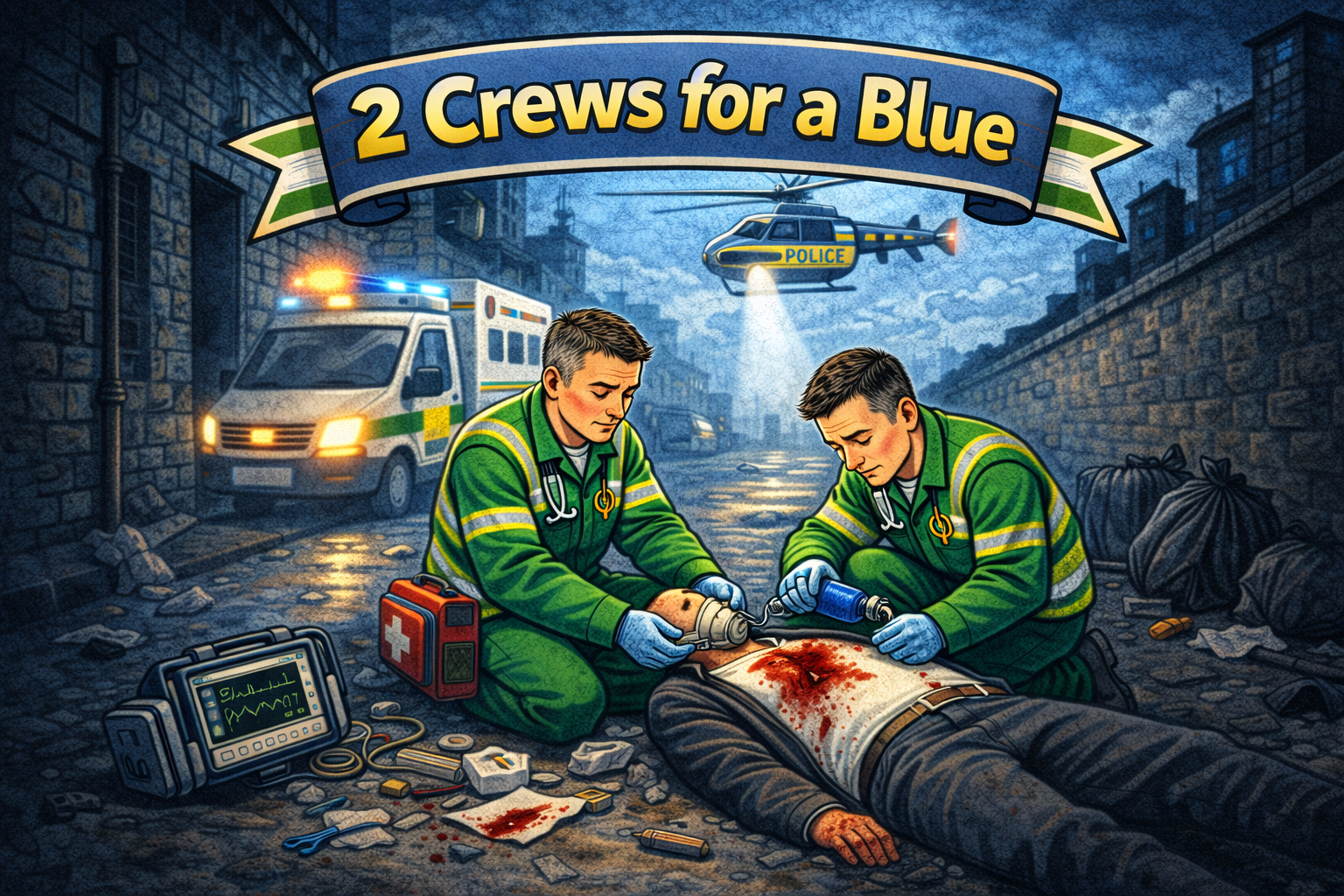
The tannoy message that always turned my stomach when I started was: “2 crews for a blue.” The first time I heard it, I looked at my crewmate like I’d missed a memo. He didn’t look surprised. He just said, calmly, “That’ll likely be a punishment shooting or a punishment beating,” and that was the thing. Those jobs weren’t rare enough to be shocking, but they weren’t common enough to be routine either. They sat in a grim middle ground that became part of the background noise of the era: you didn’t seek them, you didn’t want them, and you never forgot they existed because whatever you called it—community justice, vigilantism, or any other phrase that made it sound tidier than it was—the effect was always the same. The ambulance crew didn’t just arrive to treat an injured person. You arrived to step into a situation shaped by intimidation, legacy power structures, and unspoken rules that everyone else in that street seemed to understand instinctively.
We’d often get dispatched to calls that were vague by design, because vague was safer. “Male injured.” “Possible shooting or assault,” or “Person bleeding,” was just enough detail to get wheels turning, not enough to build a neat story in your head. The first thing I learned quickly was that the injury wasn’t always the most complicated part. Clinically, my crewmate and I could deal with wounds, fractures, trauma, shock, pain, bleeding—because that’s the job. The complicated part was the environment. The atmosphere. The way people looked at us. The way they didn’t look at us. The way conversations were measured and controlled. The way information was withheld—not necessarily out of malice, but out of fear of what might happen if someone said the wrong thing to the wrong person.
Sometimes, from the start, you could tell the job was being handled carefully. If the ambulance service received information that needed to be passed on, it might be shared with other agencies in parallel, while crews were still en route. That could leave you with the strange feeling of being very visible, very early, and very aware that we were stepping into something we didn’t control. There were calls where I arrived, and the scene felt wrong before I even saw the patient. Not dramatic—just tense. A street that looked ordinary but had an edge to it. The sort of quiet where people aren’t relaxing; they’re listening. I’ve turned up to a suspected shooting and heard the police helicopter overhead—the steady thump-thump-thump reminding me that somebody else was watching too—yet still no sign of any police vehicles on the ground. It’s an odd feeling, standing there in an ambulance uniform, very visible, trying to look like I belong while also thinking: Right… keep this simple. Keep it moving.
When we went in, the pattern was often the same. The patient didn’t want to talk—sometimes because they couldn’t, sometimes because they wouldn’t. Some would claim innocence: mistaken identity, wrong place, wrong time. Others genuinely acted baffled at why it was them. And you’d hear the same line over and over again, delivered with the weary disbelief of someone who can’t quite accept what’s happened: “I was just going to the shop… just going for a pint of milk… just grabbing bread for my granny.” And then you’d see the injuries. Sometimes it was the ankles. Sometimes the knees. Sometimes the elbows. Sometimes, what the street calls “kneecapping”—a slang term that sounds almost casual until you’re staring at the consequences of it. And if the “reason” was deemed serious enough, you might see multiple joints involved in what people grimly referred to as “the six pack.”
Families, if they spoke at all, spoke in half-sentences. They gave the bare minimum as if every extra word carried risk. Neighbours might stand back—watching, not engaging—the kind of watcher who isn’t there to help and definitely isn’t there to chat. I could feel that I was being observed, not necessarily aggressively, but deliberately. That’s where I learned what professionalism really means. Not the polished version from a classroom, but the working version. I did the job anyway—calmly, clinically—without demanding explanations I wasn’t going to get. I asked my crewmate what they needed for care and let the rest fall away. I learnt to read the room fast: what’s safe to ask, what isn’t, and when pressing for detail would only tighten the atmosphere
And I learned something else too: on some streets, we were never truly “just the ambulance crew.” Even if it was only your crewmate and you with another crew, the street could feel like it had its own unofficial audience. People positioned a little too neatly on corners. A car rolling past a bit too slowly. A face at a window that disappears the second you look up. More than once, I’ve had a crewmate quietly say, “Keep an eye on that,” and you’d understood without needing a full explanation. Not paranoia—just awareness. Sometimes the same awareness included the unsettling thought that the car easing out of the street might not be a coincidence, and might have more to do with the job than anyone wanted to say out loud. You didn’t do anything dramatic with that information. You didn’t become the main character. You didn’t start acting like you were in a crime drama. You just worked efficiently, stayed focused, and didn’t linger longer than you had to.
The reality was simple: you weren’t there to solve the wider situation. You were there for the patient. Treat the injury. Manage the pain. Watch for shock. Package. Move. Keep the patient’s dignity intact. Keep the crew safe. Keep the scene from becoming bigger than it needed to be, and when police did arrive, you’d sometimes notice how quickly the “watchers” melted away. Nobody wanted to be asked questions. Nobody wanted to be identified as a witness. In that era, being noticed could be dangerous all on its own.
You left those jobs the same way you left every job: reset, restock, move on. But you didn’t forget how they felt. The tension. The silences. The way a street can be full of people and still feel empty. Those calls taught you something that stays with you: in Northern Ireland, medicine doesn’t always happen in a neutral space. Sometimes you’re treating injuries inside a community that’s still living with fear, still governed by unspoken rules, still shaped by a past that never quite fully packed up and left. So yes—we kept the tone steady. We kept the jokes for later. We did the job properly. And we got out. Because sometimes the safest, smartest thing you can do is good clinical care delivered quickly, quietly, and without making yourself the headline, and the thing that still sticks with me is how precise those acts could be, which sounds odd until you’ve seen it.
They weren’t random street brawls. They weren’t accidents. They were deliberate injuries, designed to punish and warn—often enough to permanently change someone’s mobility, confidence, and future. Sometimes the injuries were obviously severe. Other times, the patient looked “fine,” but the mechanism told me everything I needed to know about what might be developing under the surface. The body can hide a lot in the early stages of trauma, and in those situations, I never took reassurance from appearances alone. I also learned something about pain on those jobs. Not just physical pain, but layered pain—humiliation, fear, anger, resignation. A patient might be raging. Or silent. Or cooperative in a strangely detached way, like they’d already accepted what had happened before we even arrived.
That emotional tone—flat, resigned, hyper-alert—was a clinical clue in itself. It taught me about shock, adrenaline, psychological trauma, and how safe the scene might or might not be. Safety was always on my mind, even if I didn’t say it out loud. Not because ambulance crews are paranoid, but because I learned the difference between an unsafe scene and a merely uncomfortable one. The Troubles might have been “over,” but the remnants of control and threat lingered in certain areas. People were still being managed by fear. And fear doesn’t switch off just because a marked vehicle arrives. Sometimes our presence made people more anxious, not less—because our arrival meant attention, and attention could be dangerous.
So I learned to be careful with my demeanour: calm, professional, neutral. Not nosy. Not judgmental. Just there to treat and move. In those places, neutrality wasn’t a political stance. It was an operational necessity. I wasn’t there to investigate. I wasn’t there to moralise. We were there to provide care and get someone to definitive treatment. And yet—even with that clinical focus—I couldn’t escape the reality that I was responding to the long shadow of a conflict that had shaped communities for generations. In the 2000s, many patients and families still lived in a world where trust in institutions was complicated. Depending on background and location, police might be viewed with suspicion, hostility, or fear. Even healthcare, usually seen as neutral, wasn’t entirely immune to the residue of division. I felt it in the reluctance to give details, the fear of being seen speaking freely, the tension in a street that felt too quiet.
There was also the uncomfortable truth that these calls weren’t always treated like emergencies by the people around them. Sometimes the injury was almost expected. The patient might not be surprised. The family might be grimly unsurprised. That normalisation is one of the darkest legacies of conflict: when violence becomes part of the accepted landscape. Punishment beatings carried their own complexity: multiple injuries, fractures, soft tissue damage, head injury risk, and internal injury risk. But beyond the injuries, there was always the unspoken question: Is this person safe? Are they going somewhere safe? Are they being watched? Are they going to refuse conveyance because they’re afraid of what happens next? Clinical decision-making wasn’t only about severity; it was about getting someone to care without escalating danger. Sometimes the patient didn’t even want the ambulance. Someone else called. That created its own dynamic. I’d arrive and find a patient angry that anyone had involved services—not because I’d done anything wrong, but because I represented visibility. And visibility had consequences.
Looking back, one of the most difficult parts wasn’t the gore or the trauma. It was the emotional labour of working inside a community still shaped by unspoken rules. I could see fear in the way people stood back, the way doors closed, the way someone glanced up and down the street while I worked. It reminded me that the Troubles weren’t just history. They were habits. They were social patterns. They were silent, and then we had to carry that into the next call, because the system doesn’t pause. You’d finish a job thick with tension and then be sent to an elderly fall or a child with a fever. You’d change emotional gear instantly. That kind of whiplash is part of ambulance work everywhere, but in Northern Ireland in that era, it had a particular flavour: one shift could feel like a tour through health inequality, post-conflict trauma, deprivation, and ordinary family life—stitched together by the same roads and the same radio.
The station was often where these jobs were absorbed. Not always formal debriefs, not necessarily long conversations—sometimes it was the crew-room silence afterwards, or the quiet humour that returned when people were ready. Ambulance culture uses humour as a pressure-release valve, but jobs like these often sit heavier. They weren’t easy to turn into banter because they didn’t feel absurd; they felt grimly intentional. There was a particular pride in doing the work well under those conditions. Not pride in the event—never that—but pride in maintaining clinical standards in difficult circumstances. Remaining calm. Treating the patient with dignity, even if the patient felt ashamed. Getting them to care safely. Not escalating the scene. Not becoming part of the theatre of control that those acts were designed to create.
That professionalism mattered for the patient, and it mattered for me. Because if you lose your standards—if fear or anger starts shaping how I treat people—the job changes you in ways you don’t want. Holding onto clinical neutrality and human dignity wasn’t just operational. It was psychological self-protection. Looking back, the start of my career was a strange bridging period. The political landscape was changing. Overt conflict was receding. But the social and psychological residue remained. Working ambulance shifts in that era meant being a frontline witness to a society still learning how to live without conflict as its organising principle. And that learning wasn’t smooth. It came with setbacks, violence, coercion, and long-standing tensions playing out in new forms. If I weren’t from here, it might have been hard to understand. Being from here was sometimes harder—because I recognised the cues. I understood what wasn’t being said. I knew what certain injuries suggested in certain postcodes. That local knowledge was useful and heavy. It made me sharper clinically, but emotionally it added layers: I wasn’t just responding to a patient; I was responding inside a history that had shaped my community and my own assumptions.
The public often asks about “sights,” assuming the most graphic images define the job. In truth, the defining sight of that time wasn’t always blood or broken bone. It was a quiet street where people watched without speaking. Careful language. The feeling in the air. The knowledge that the violence wasn’t random—it was structured. That’s the sort of thing that stays with you because it tells you something about a society’s nervous system long after the headlines move on.
And despite all of that, the work remained the same at its core: someone is hurt, someone needs help, and we show up. We do our best. We’d treat what we can treat. We reduce suffering where we can. We get them to care safely. We try to be the calmest people in the worst moment of someone’s day, even when that day has been shaped by forces far beyond medicine. We leave the scene behind.
Those calls—punishment shootings and beatings—were never “just another job.” They carried weight not because they were medically unique, but because they were socially loaded. They reminded us that the past was still present. And they challenged us to stay professional, compassionate, and steady in the middle of something that had no clinical justification and no easy solution.
And then you went back out again—because the radio never stays quiet for long.