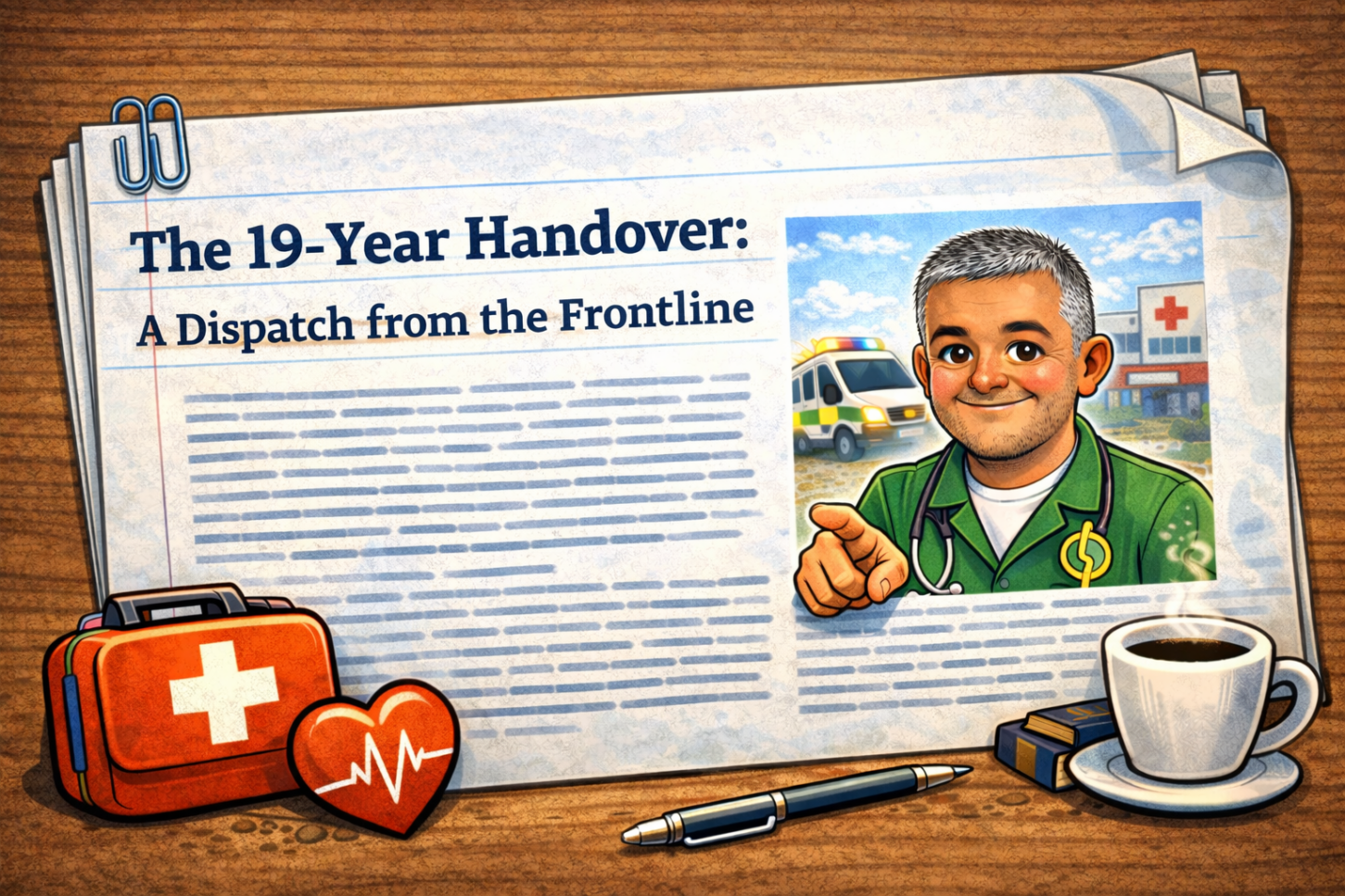
In the ambulance service, the “handover” is a sacred ritual. It is the moment where responsibility shifts from one set of shoulders to another. It happens in the sterile, fluorescent glare of the Emergency Department, amidst the beep of monitors and the frantic energy of a trauma bay. We condense a person’s worst hour into thirty seconds of clinical data: “This is a 64-year-old male with sudden onset chest pain and ST-elevation in the inferior leads. Aspirin, morphine and GTN were administered. He is stable but symptomatic.”
But after nineteen years wearing the uniform—fourteen as an Emergency Medical Technician (EMT) and five as a Paramedic—I’ve realised there is a second kind of handover. It’s the one we never give. It’s the handover of the things that don’t fit on a PRF (Patient Report Form). It’s the accumulation of every missed family dinner, every “late call” that pushed us three hours past our finish time, every “can you walk?” assessment that turned into a battle of wills, and every silent drive back to base after a job that left a mark on the soul.
I’m starting this story because my internal rucksack is full. This is my nineteen-year handover to you.
I stepped into the EMT role in 2007 straight from a desk job in the NI Civil Service. To the students currently in university, 2007 must feel like the Victorian era of medicine. Back then, the service was different. We were at the tail end of the “scoop and run” philosophy. Our job was often defined by the speed of the Mercedes Sprinter rather than the complexity of the clinical intervention. We had paper PRFs that would disintegrate in the Northern Irish rain. If you got lost in the backstreets of West Belfast or the farm lanes of Fermanagh, you didn’t have a tablet with a GPS—you had a tattered A-Z map and a partner who was hopefully better at reading it than you were.
The staff uniform then was a blue shirt and navy trousers, a style that had been in place since the service was established in 1995. This was officially changed to green in 2016. The move was intended to align with other ambulance services across the United Kingdom. Most ambulance services in England, Scotland, and Wales already use the distinctive bottle-green uniform, making Paramedics and EMTs “instantly recognisable” as healthcare professionals regardless of which region they are in. The change helped to clearly distinguish ambulance staff from other emergency services, such as the police (who wear dark blue/black) or other agencies that used similar blue workwear. Leadership at the time stated that the new look reflected the “major changes” taking place within the service. It was seen as a visual marker of the service evolving toward more advanced clinical care pathways and modern Paramedic practice.
The fourteen years I spent as an EMT were the years when I learnt the “dark arts” of the road. People often ask why I waited so long to “step up” to Paramedic. The truth is, I loved the grit of the technician role. As an EMT, you are the foundation of the crew. You are the one navigating the physical and social chaos of a scene while the Paramedic focuses on the physiology. I learnt how to talk a frantic mother down from a panic attack, how to negotiate with a drunk who wanted to fight the oxygen cylinder, and how to spot a “sick” patient from the doorway before a single piece of kit was unpacked. I also got annoyed and fed up with not being able to do the most for my patients, as I was restricted in what I could do in my scope of working practice.
After I leapt and became a Paramedic, the responsibilities once carried by my former Paramedic crewmate now rested on my own shoulders. Suddenly, the “brown envelope” fear became real. The regulatory body for Paramedics, the Health and Care Professions Council (HCPC), was no longer an abstract concept; it was a silent auditor sitting on my shoulder at every scene or an imaginary noose around your neck, which could result in me losing my job. Being the lead clinician meant you could be the highest authority or the only one in a thirty-mile radius at 3:00 AM. There is no “consultant review” in a rainy lay-by. There is just you, your partner, and the decisions you make in the dark.
Nineteen years in this service does something to your anatomy. My spine is no longer a stack of vertebrae; it’s a collection of grievances. I’ve spent two decades lifting “non-weight-bearing” giants out of bathrooms the size of phone booths. I have developed a “Paramedic Gait”—a slight leftward tilt from the weight of the response bag—and a permanent squint from trying to read house numbers that people deliberately hide behind overgrown ivy. But the physical toll is only half the story. The “Auld Hand” persona isn’t born from a lack of empathy; it’s a survival mechanism. We use dark humour as a surgical instrument to cut through the tension. We joke about the “Ambulance Control diet” and the “yellow cubicle chronicles” because if we didn’t laugh at the absurdity of spending six hours waiting outside the hospital emergency department while the radio screams for “Anyone available for a Cat 1 call” cover, we’d likely never get back in the ambulance.
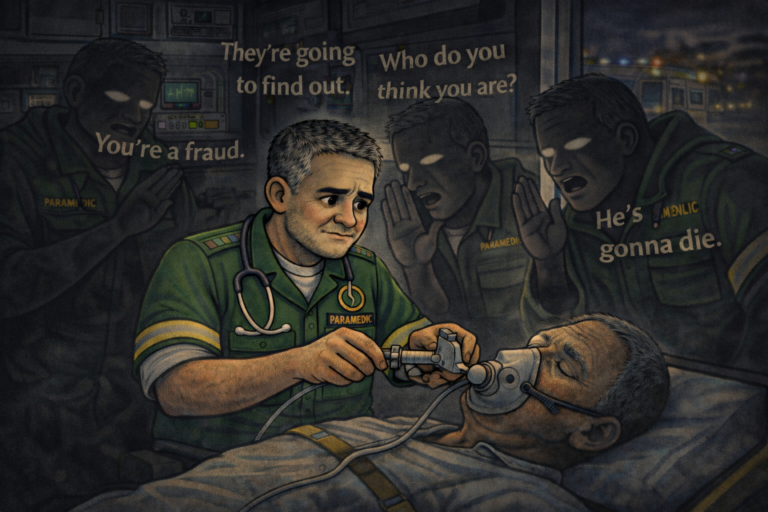
“Imposter Syndrome” is a constant companion in this handover. You’d think that after nearly two decades, I’d walk into every house with the confidence of a god. The reality is that the more you know, the more you realise how much can go wrong. I still have that flicker of “palpitations” when the MDT chirps a high-acuity call. I still wait for someone to tap me on the shoulder and tell me they’ve realised I’m just winging it. But nineteen years have taught me that this doubt is actually my greatest clinical asset. It’s the thing that makes me check the pulse one more time and verify the drug dose twice. It makes me a “Reasonable Paramedic” instead of an arrogant one.
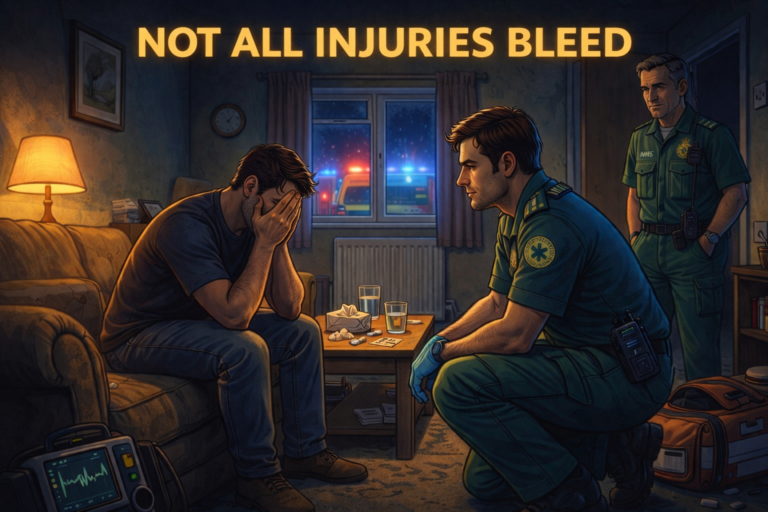
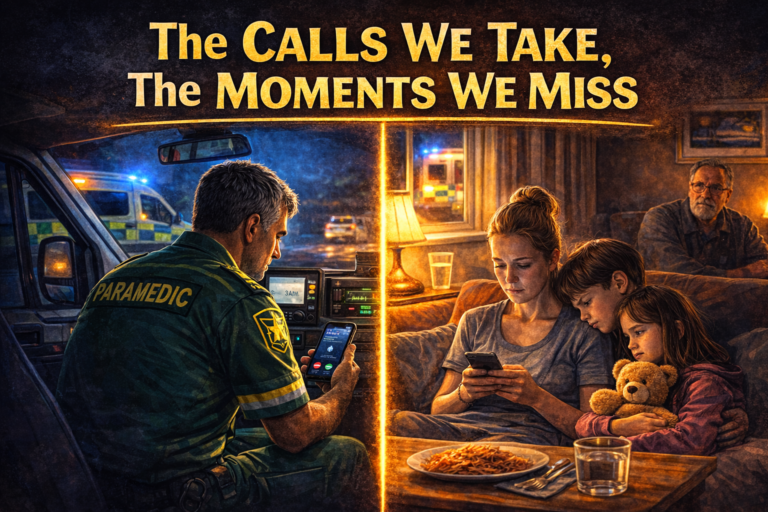
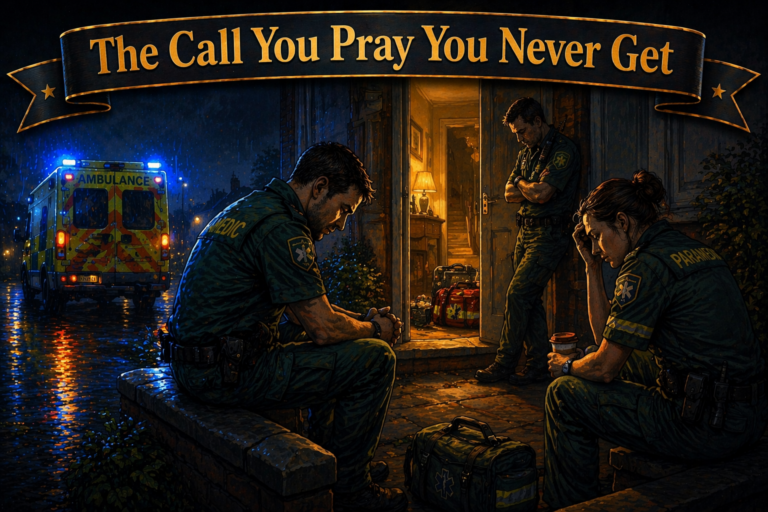
This blog isn’t going to be a collection of hero stories. The world has enough of those, and you can see them on any TV programme. I’m not here to tell you about the time I “saved a life” with a dramatic intervention (though those happen). I’m here to tell you about the time I missed my daughter’s school concert because I was stuck on a social call that wasn’t an emergency, but the patient had nobody else to talk to, or the friend’s BBQ, because I couldn’t get the leave I applied for 6 months in advance. I’m here to talk about the “Silent Debrief”—the long, heavy drive back to base after a paediatric arrest where nobody says a word because there’s nothing left to say.
Not only do I write this for the “new starts” who arrive on station with pristine boots and a university degree, but also for the general public who only get to hear about the ambulance service from what they are told by either management, the press or social media. I want you to know that the saltiness you see in the “Auld Hands” isn’t bitterness—it’s armour. We are protecting the core of ourselves so we can keep doing this job for another shift, another week, another decade. I want to bridge the gap between your academic evidence-based practice and the “Road Reality”, where the evidence doesn’t always account for a patient who lives in a hoarder’s house with three aggressive dogs and a broken staircase.
As I sit here typing this, my back is clicking in Morse code, and I’m on my third cup of tea. I’m nineteen years into a shift that feels like it started yesterday. Today, like most, if not all, ambulance and health services are flawed, beautiful, frustrating, and essential beasts. It has given me a front-row seat to the best and worst of humanity.
So, here is the handover:
- Patient: The Health Service in Northern Ireland.
- Presenting Complaint: Chronic exhaustion, acute resource depletion, but a heart that refuses to stop beating.
- Treatment Plan: One part clinical excellence, two parts dark humour, and a heavy dose of honesty.
Pull up a chair wherever you may be. The kettle’s just boiled, and for once, the radio is quiet. Let’s talk about the road.