Long before we reach the patient, the job has already begun. It starts in the seconds after the call comes through the tannoy – the address appears on the screen, the satnav wakes into life, blue lights flicker across the dashboard, and the siren cuts into the ordinary rhythm of the road. From that moment on, before a single word is spoken to a patient or a hand is laid on a piece of equipment, another obstacle stands between us and the call.
The road.
For most people, the road is routine. The space between home and work, the school run, the supermarket, the weekend drive. Something to move through without much thought. For those of us responding under emergency conditions, it becomes something else entirely: a constantly shifting environment shaped by the decisions of every other driver around us. Those decisions can either open a path or close it without warning
Many people assume that when an ambulance activates blue lights and sirens, the normal rules of the road disappear. That we can drive however we like, that traffic lights and speed limits no longer apply. In reality, emergency driving operates under strict legal exemptions, not freedom. Every action must be justified, safe, and proportionate. The exemptions are narrow.
They allow us to exceed the speed limit, treat a red light as a give-way, and pass on the wrong side of a keep-left bollard — but only if doing so is necessary and only if a reasonable observer would agree it was safe. The phrase that sits behind every decision is “due regard”. It is not a slogan. It is a legal standard, and when something goes wrong, it is the standard against which the driver will be measured. The lights offer urgency, not immunity.
Because of that, emergency driving is not about speed. It is about progress — reading the road, anticipating behaviour, and moving through safely while everything around you reacts in real time. That reaction marks the real challenge.
Some drivers respond by accelerating. The lights appear in their mirror, the siren follows, and instead of easing aside, they press on. What may begin as an attempt to help quickly turns into a moving barrier. The vehicle stays just ahead, unintentionally dictating the pace. Overtaking becomes more complex, sitting behind wastes time, and the situation tightens into something it was never meant to be. We are not trying to race anyone. We are looking for a safe, predictable gap.
Occasionally, it goes further than that. I remember one driver who appeared determined to stay ahead of us no matter what. Every time we found an opportunity to pass, he accelerated. Every time the road opened up, he overtook again, weaving into the gap we needed. For a stretch of road, it felt less like an emergency response and more like the Monaco Grand Prix, with one of us obliged to win and the other apparently unaware there was a race on at all. Eventually, he peeled off at a junction and was gone. Whether he ever realised what he had been doing, I have no idea.
Inexperience is a category of its own. Learner drivers and R-plate drivers, who are still working out the basics of road position and observation, are not equipped to handle the sudden arrival of an emergency vehicle in their vicinity. You can sometimes see it happening in real time — the indicator going on, then off, then on again; the car drifting toward a kerb that is closer than they realise; the brake lights flashing in short, uncertain pulses. None of it is bad intent.
It is simply a driver being asked to make a decision they have not yet been taught to make, often with an instructor in the passenger seat trying to talk them through it calmly while a four-and-a-half-tonne ambulance fills their mirror. The right thing to do in those situations is to back off slightly and give them time. Pressuring an inexperienced driver into a quick decision produces the opposite of what you need.
More often, the response is hesitation. You can see the moment recognition hits – the mirror check, the slight drift in the lane, the uncertainty. Vehicles slow abruptly or stop altogether, unsure of where to go. One hesitation spreads to another, and within seconds, a flowing road becomes static. The instinct is to stop, but in doing so, the space we rely on disappears. When traffic moves slowly and predictably, we can work with it. When everything stops, the road closes.
Then there are the sudden brakes – a flash of red lights ahead and a sharp deceleration. In a car, it feels manageable. In an ambulance, everything changes. The vehicle’s weight carries forward, braking distances lengthen, and in the back, a clinician may be kneeling beside a patient, a cannula in hand, or steadying a drug draw against the sway of the cab.
Smooth progress matters as much as speed. A single sharp stop can send a tray sliding, a line pulling, and a careful piece of work undone. The driver up front is not just driving for themselves. They are driving for the person in the back, who has both hands occupied and no way to brace.
Sometimes the issue is not speed or hesitation, but positioning. Drivers try to help by moving aside but end up sitting at the same level as the vehicle beside them, unintentionally blocking the road. From our perspective, only a small adjustment would open a clear path, yet both vehicles remain fixed, each waiting on the other. What was meant as assistance becomes an unspoken standoff.
Road design adds its own complications. Traffic islands, pedestrian refuges, and central reservations narrow already tight spaces. When vehicles stop alongside them, the available width disappears. The driver ahead may believe they have moved as far as possible, but the kerb says otherwise. These situations are rarely caused by poor intent. Most people simply never have to think about how a four-and-a-half-tonne emergency vehicle navigates through confined spaces.
Cities have their own logic. Narrow streets, bus lanes, cycle lanes, parked cars on both sides, and pedestrians stepping out because they heard a siren and assumed it was further away than it was. Rural roads have their own. Hedgerows that block sightlines, single-track stretches where there is genuinely nowhere for an oncoming car to go, tractors and farm vehicles that cannot move quickly even when they want to. In my experience, country drivers often respond better than urban ones. They are used to giving way. They are used to reversing into a gateway to let something pass. The city is faster but tighter; the country is slower but more generous.
Pedestrians are their own consideration, one we don’t always talk about. People step out from between parked cars without looking because they are crossing a quiet street they have crossed a hundred times before. They walk along the pavement with headphones in, lost in music or a podcast, unaware that a siren is approaching from behind. They read books at bus stops and look up only after the ambulance has passed. Children chase each other across pavements. Phones are everywhere. The assumption that a pedestrian has heard you, seen you, or registered you in any way at all has to be set aside entirely. You drive on the basis that they have not.
Slow-moving vehicles pose their own challenges, particularly outside towns. A tractor pulling a wide trailer on a country road has very little it can do for you. A combine harvester taking up most of the available width has even less available width. The driver may be entirely aware of the ambulance behind them and entirely willing to help and still physically unable to pull in because there is nowhere to go. You sit behind, with the lights on and the siren off if it is just causing distress, and you wait for a gateway or a passing place. There is no point in frustration. The vehicle in front of you cannot disappear, and pushing past it on a blind country bend is not a decision any reasonable driver would make.
Cyclists add another layer in both settings. In urban traffic, a single cyclist is usually no real problem — they are alert, they are watching their mirrors, and they can move into a gap quickly. Groups of cyclists are different. A pack of riders taking a full lane, particularly on a country road, can occupy the entire usable width for a considerable distance. They are entitled to that road space, and they are often more aware of an approaching emergency vehicle than the average driver. But a group of fifteen riders cannot compress into a single file at speed, and the road ahead may not offer them a safe place to pull in. The situation resolves itself eventually, but it resolves on the road’s terms, not ours.
At times, the difficulty is simpler still. Drivers do not realise we are there. Modern cars are insulated environments. Windows were closed, music was playing, conversations were ongoing, the satnav was speaking, and phones were connected through the dashboard. The outside world fades until the siren is almost on top of them. Newer cars are quieter still – better seals, better sound deadening, and electric drivetrains that make almost no noise themselves. A siren that would have been audible three streets away thirty years ago might not register until we are two car lengths behind. When awareness finally comes, the reaction is sudden and often unpredictable. For that reason, every vehicle is approached on the assumption that we have not yet been seen or heard.
Inside the cab, the work is shared. Emergency response driving is rarely a solo task. The crewmate in the passenger seat serves as a second pair of eyes, watching the junctions you cannot see, calling traffic from the left, and confirming that a side road is clear before you commit to it. “Clear left.” “Hold, cyclist.” “Your side.” Short phrases. No wasted words. There is a rhythm to it that develops between crews who have worked together long enough, a shorthand that doesn’t need explaining. You learn each other’s tells – the slight intake of breath before a warning, the hand that goes up without speaking, the moment one of you sees something the other hasn’t. Good communication in the cab is not about volume or urgency. It is about clarity, timing, and trust.
There is also the running internal commentary that every emergency driver learns. The car ahead is indicating right—will they go right, or have they forgotten the indicator is on? The pedestrian on the kerb is looking at their phone rather than the road. The driver in the wing mirror three cars back has just seen us—watch what they do next. The cyclist has space to move left, but might not. You are not just watching the road. You are watching every set of eyes on it, trying to predict what each person will do half a second before they do it. Most of the time, you are right. Occasionally, you are wrong, and the margin you have left yourself is the only thing that matters.
This is why emergency driving demands more than just technical skill. It requires observation, anticipation, and control under pressure – reading patterns, predicting behaviour, and planning several seconds ahead. Communication within the cab becomes part of that process, with both crew members watching, assessing, and guiding. Above all, it requires calm. Urgency without control helps no one.
For all the frustration that can come with the road, something else becomes clear over time. Most people are trying to help.
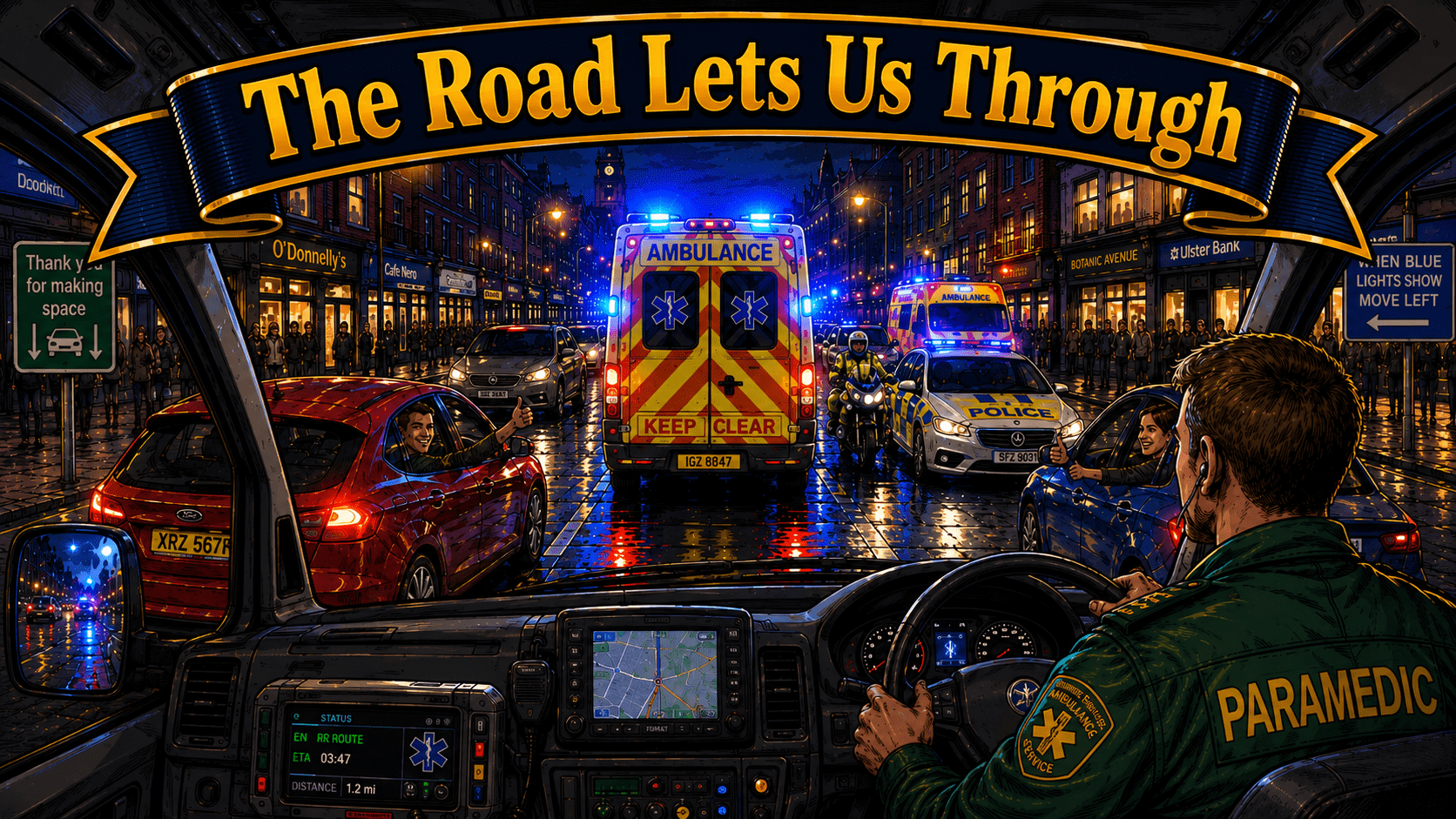
They do not know where we are going. They do not know the circumstances or the urgency behind the call. All they see is an ambulance approaching, and instinct tells them to make space. Sometimes they do it perfectly — a slight adjustment, an early signal, a steady movement to the side. The road opens just enough, and we pass through smoothly. No words exchanged, no acknowledgement given, but for that brief moment, there is cooperation between strangers working toward the same outcome.
Occasionally, there is a small gesture afterwards. A raised hand from a driver as you pass. A nod through a windscreen. A flash of headlights from somebody who pulled in tight against a hedgerow to let you through on a country road. You do not always have a free hand to acknowledge it back, and they probably do not expect you to. But it registers. It matters. Somewhere on the other side of that gesture is a person who chose to do the right thing for someone they will never meet, on behalf of someone else they will never meet either. That is a quietly remarkable thing, and it happens dozens of times on a single shift without anyone marking it.
Emergency response is often imagined as something carried out solely by those inside the vehicle. In reality, it is shared. Every driver who checks their mirrors, keeps their movements predictable, and creates space when they can, and every pedestrian who looks both ways when crossing the road and waits before crossing becomes part of that response. They help us reach someone faster, and just as importantly, they help us get there safely. The patient will never know their names at the end of the call. Neither will we. But they were part of how we got there.
Before any patient is seen, before any intervention begins, the journey has already demanded judgement, patience, and constant awareness. It is a part of the job rarely considered, yet it shapes every response.
Between the station and the patient lies a moving landscape of decisions, reactions, and intentions. Sometimes it slows us down. Sometimes it creates risk. But often, in small and almost unnoticed ways, it gives us exactly what we need.
A gap opens — the traffic shifts.
And for a moment, the road lets us through.