I was raised to believe in the police. That is worth saying at the start, because it shapes everything that follows. My earliest memory of them is the local officers from Donegall Pass Station visiting my grandparents’ house. Not for any emergency. Not for any trouble. Just a visit, the way things were done then, the police as part of the community rather than apart from it. That is the version of policing I grew up with, and it stayed with me longer than I realised.
As a teenager, the relationship shifted in the way most teenagers’ do, which is to say, it became adversarial in small, stupid, entirely avoidable ways. One evening, a group of us were in the Botanic Gardens with a bag of tins we had managed to acquire by sending the oldest-looking among us into the off-licence with a fake ID, which, amazingly, had worked. We were sitting in the park, feeling very pleased with ourselves, when two police officers appeared from nowhere and asked who owned the alcohol. We all knew we were underage. They knew we knew. They put the fear of God into the lot of us, picked up the bag of tins, and said, “Whoever owns this beer, tell them to come and pick it up at Donegall Pass Station.” Nobody was going to own up, and they knew that too. We watched them walk off with it, and the consensus, spoken quietly and bitterly on the walk home, was that those tins were either going to be drunk at the station or taken home for a quiet evening. Either way, they were not coming back to us.
There was also, underneath the comedy of it, a genuine fear of bringing trouble to your parents’ door. That was the culture. If you did something that brought the police to the house, you would get a cuff around the ear from the officer, and then, if you were foolish enough to tell your parents what had happened, you were guaranteed another one from them. The police and the parents operated on broadly the same system, and neither side saw any contradiction in it.
Before I joined the ambulance service, I had many dealings with the RUC, both inside and outside my previous employment. I worked in the civil service in Churchill House, and they were a regular presence there. Some came to the Police Authority section, which looked after the RUC’s building side. Others came to the Public Records Office, either dropping off material for storage or collecting records that at times related to murders carried out during the Troubles. You handled those files with a particular awareness. You knew, in general terms, what they contained and what they represented, and you processed them and moved on because that was the job, and that was the time.
I have met many fine police officers in my life. I have drunk with them, socialised with them, and known them as people rather than uniforms. But I also met some who, despite wearing that uniform, made a normal event into one I would never forget. One night, I was driving through a predominantly Catholic area – genuinely on my way to see friends, nothing more – and was stopped by a foot patrol. I handed over my driving licence. The officer looked at it, noticed where I was from, and stuck the muzzle of the gun he was holding within two or three inches of my head. He asked why a “fucking prod” was in the area. I told him I was visiting a friend, which was not a crime. He threw my licence back into the car and told me to be on my way. Up to that point, I had only read about how certain officers treated certain sections of the community. I had thought some of it might be exaggerated. After that night, I knew it was not. I reported it to officers I knew. I never found out whether anything came of it.
That is the context. That is what sits behind the relationship before the ambulance service even enters the picture. A childhood spent believing in the police. A teenager’s encounter with them that, looking back, was exactly as it should have been. A working life that brought me close to the operational reality of policing in Northern Ireland during the Troubles. And one night on a dark road, that showed me what the uniform could look like when the wrong person was wearing it. All of that came with me when I started in the ambulance service, and all of it shaped how I understood the police officers I would spend the next nineteen years working alongside.
The RUC became the PSNI in 2001, and the hope was for a more inclusive police service in Northern Ireland — one that would attract candidates from across the community rather than predominantly from one side. Many of the old RUC officers had taken the early severance package under Patten before the changeover, which meant the service lost a great deal of experience in a very short time. But when you worked alongside the PSNI in the ambulance service, you could still see the old RUC officers in the ones who had stayed. It was in their mannerisms. The way they talked. The way they held themselves during incidents. The way they arrived at a scene and took control without announcing themselves.
One incident stands out as the clearest example of the difference. We were tasked with conducting a welfare check on a patient who had not been seen in several weeks. Friends had noticed the lights were on in the house, but the doors and windows were locked, and nobody could get in. We arrived, opened the letterbox, and the stench of death hit us immediately. Decaying flesh. It’s unmistakable once you have smelt it, and you never forget it. Because forced entry was required, we requested assistance from the PSNI.
Two officers arrived. Young. One of them looked as though he had only just left secondary school. We explained our suspicions. What followed was a conversation about the legality of forced entry that lasted considerably longer than the situation warranted. European law. Human rights. The question of authorisation. The paperwork that would need to be completed if the house were empty. My crewmate and I stood there, the smell coming through the letterbox, listening to a discussion that the situation had already answered.
After about twenty minutes, a police armoured jeep pulled up, and a sergeant climbed out. Six foot tall, with all the airs and graces of the old-style RUC peeler. He came straight over to me and asked what was wrong. I told him. He called the two young officers over and asked them why they had not yet forced entry. You could see them making their case – that it was only on our word that the house might be empty and that the paperwork would be considerable. The sergeant listened. Then he told them to stand back.
Bam. His size-eleven boot hit the front door, and the whole frame rattled. Bam. Bam. Three kicks and the door was open. Inside, we found the badly decomposed body of a person who had clearly been dead for some time. The sergeant called the two young officers in, showed them what was in the room, and gave them a telling-off that they were unlikely to forget. He told them that if they were ever in the same situation again and the ambulance crew wanted forced entry because of their suspicions, they were to go ahead and do it. No discussion. No twenty-minute conversation about European law. Just do it.
That scene contained the entire transition from RUC to PSNI in miniature. The new officers were not wrong to think about the law. They were not wrong to consider the paperwork. They were doing what they had been trained to do, and that training was a product of the changes the service had undergone. But the sergeant, with his size eleven boots and his instinct for when a situation called for action rather than deliberation, represented something the newer service had not yet fully replaced – the kind of operational confidence that comes from years of doing the job in conditions that left little room for hesitation.
You could see the same difference across Belfast’s divisions. Officers from West Belfast and East Belfast tended to take no nonsense. You got one warning if you weren’t complying or doing something wrong, and then firmness set in. Officers from South Belfast and the city centre divisions seemed to have more patience, a softer approach, and a willingness to talk things through before escalating. Both styles had their place. Both worked in the right context. But there were calls where you needed the brute-force end of the spectrum, where the situation required someone who would take control immediately and without negotiation. In those moments, the softly-softly approach could leave you standing in a scene, wishing for something more direct.
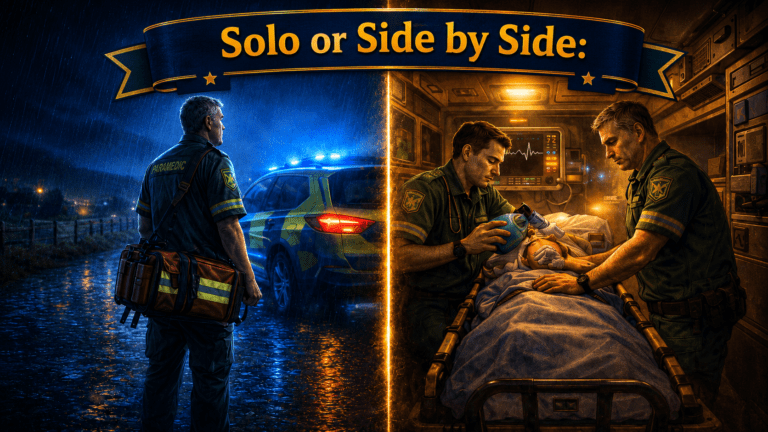
On paper, the relationship between the ambulance service and the police makes sense: two services, two distinct roles. We treat patients. They manage safety, law, and control. But the reality is that we meet in the middle far more often than either side probably expected when they joined, and that middle ground is not always tidy.
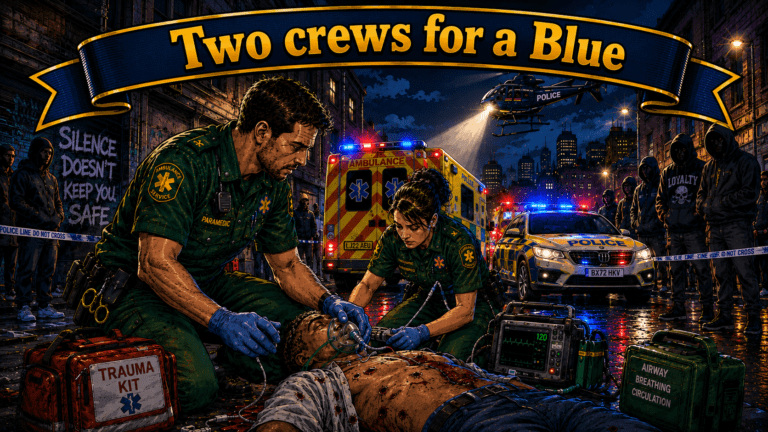
There are situations in which clinical care cannot begin until the environment is safe. There are patients you cannot approach without support. There are situations where what is happening is not just medical but also behavioural, unpredictable, and sometimes volatile. In those moments, your role shifts. You are still there to treat, but you are also assessing risk in a way that is not entirely natural to the job, because your training prepared you for the patient, not for what the patient might do if no one else were in the room.
The waiting is real, and it would be dishonest to write about this relationship without saying so. There are jobs where you need police, and they are not there. Not because they do not want to be. Not because they do not understand the urgency. But because they are somewhere else, at another job, making the same decisions about priorities and resources that we make every shift. The system is stretched. Both systems are stretched. And when two stretched services rely on each other, the gaps show. From the outside, it can look like a delay. From the inside, it is prioritisation. And that is a distinction you only really understand once you have been part of it.
But when both services are present, something changes. The job becomes more manageable. Not easier, necessarily, but clearer. Roles settle into place. The police manage the environment. We manage the patient. And that division, when it works, allows both sides to do their job properly – the version of the job you trained for, rather than the improvised version you do alone.
Mental health calls sit right at the centre of this dynamic. A person in crisis is not always a medical emergency. They are not always a matter of policing. They exist somewhere in between, in a space that neither service was originally designed to occupy on its own. You arrive at someone who may be distressed, agitated, withdrawn, confused, or any combination of these. They may need care. They may need protection. They may need both. But what they need and what the system is set up to provide do not always match, and the gap falls on whoever is standing in the room at the time, which is usually us. From the police perspective, those same calls look different. They see volume. They see demand on a scale that has grown enormously. They are making the same calculations we are—where am I most needed, what can wait, and what cannot. Fairness requires saying that.
What I noticed in the newer officers I respected was a readiness to engage. A willingness to work alongside us rather than around us. To ask questions when they were unsure, which takes more confidence than pretending to know. To stay at the scene longer than strictly necessary because they could see the situation was not resolved, and the ambulance crew could use the company. Those small decisions — the decision to stay, to check in, and to come back past a scene twenty minutes later to see if things have settled — are not in any protocol. They are choices made by individual officers, and they matter more than any formal inter-agency agreement ever will.
Over nineteen years, you stop seeing uniforms and start seeing people. You recognise officers. You learn how certain people operate. Who communicates clearly. Who reads a scene quickly? Who steps in at the right moment without being asked. That familiarity builds the kind of trust that allows two people from different services to walk into a volatile room together and know, without discussing it, who will speak first and where they will stand. You cannot train that. You can only accumulate it.
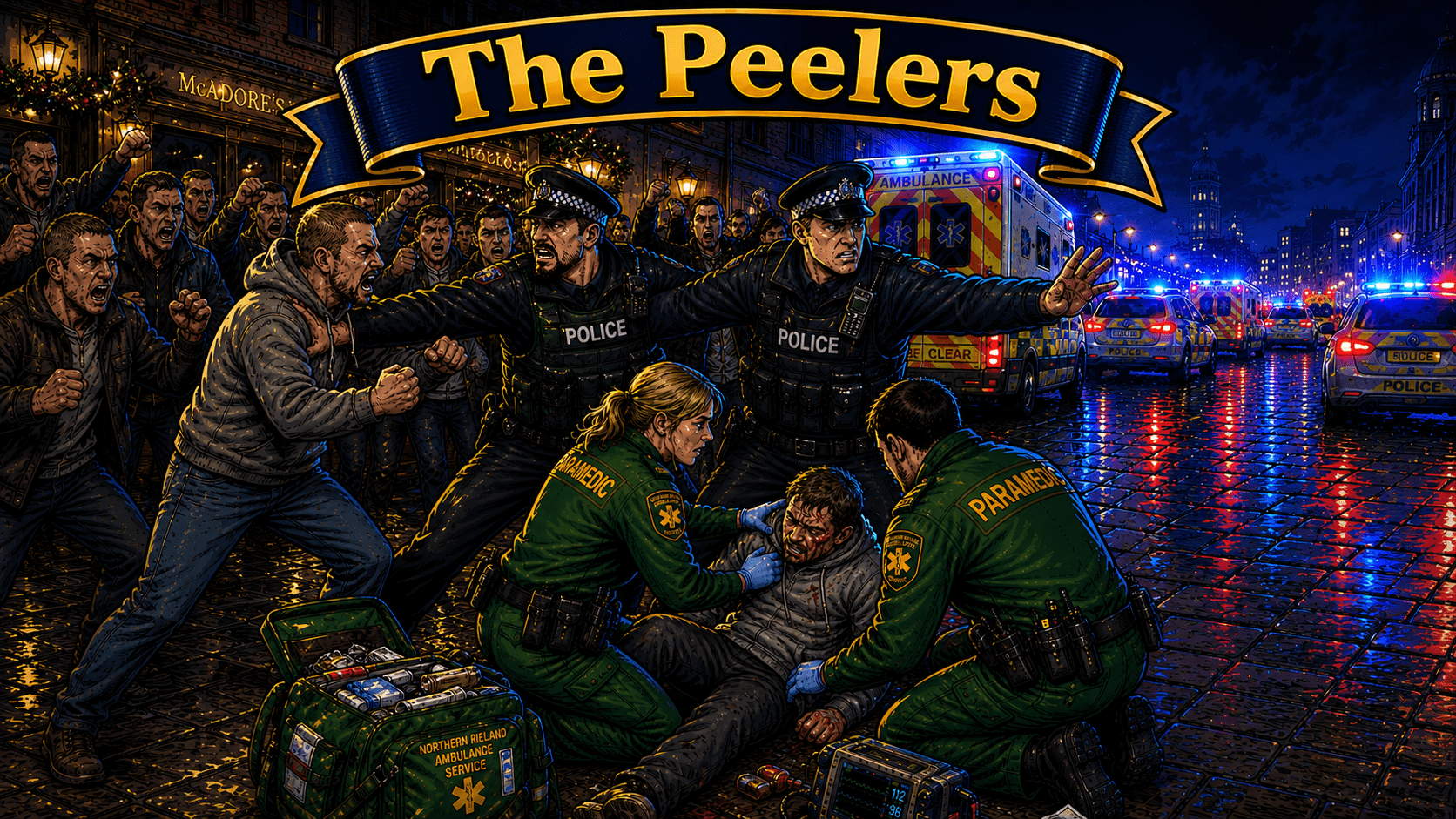
There are also the small, practical things that officers do at scenes, which nobody trains them for and which deserve to be mentioned because they are easy to overlook—holding a torch so you can work; clearing a path through a crowd so you can get the stretcher through; standing at a front door in the rain so that nobody who should not be coming in comes in, without being asked, without needing to be told, just reading the scene and finding the thing that needs doing. Carrying equipment to the ambulance when your hands are full, and your back is finished, and you did not ask for help, but the help appeared anyway. Those things do not appear in any report or statistic about inter-agency cooperation. They are also the things you remember years later when somebody asks you what the relationship was actually like.
The relationship goes both ways. If the police provide us with safety, we provide something in return, even if it is less easy to name. We provide a way in. Some people will not open a door to a police uniform, but who will open it to an ambulance crew? And every officer who has worked in communities where the history of policing is complicated understands this without needing it explained—a green uniform beside a dark one. A paramedic bag is on the floor instead of handcuffs. It is not a trick. It is simply the reality that different uniforms carry different associations, and in certain rooms, at certain hours, ours is the one that gets the door open. We know this. They know this. And neither side pretends otherwise.
The relationship is not perfect. It was never going to be. Two services, different pressures, different demands, working in the same space with the same patients at the same unsociable hours. There will always be moments where it does not quite line up, where the radio goes quiet when you need it to be loud, where you are standing on a scene alone, wishing for the sound of a second vehicle pulling up behind you. That tension is built into the system. But over time, you start to see it differently, not as a failure of the relationship, but as a reflection of what both services are working with — the same shrinking resources, the same expanding demand, the same impossible arithmetic of trying to be everywhere at once with not enough people.
What stays with me, looking back, is not the frustration. It is the sergeant with the size-eleven boots, kicking in a door because the situation required it, and the paperwork could wait. It is the young officer who stayed at the scene longer than she needed to because something about it had not sat right with her. It was the officer who stood with a family in a hallway while I worked on someone in the next room, not because anyone had asked him to, but because the family needed somebody and he was there. It is the two officers in the Botanic Gardens, walking off with our beer, knowing exactly what they were doing and doing it with the kind of quiet authority that I did not appreciate at the time but that I recognise now as good policing.
Those moments are not the exception. They are in a relationship. Everything else — the waits, the radio silences, the nights where you are alone on a scene wishing you were not — is the cost of two services trying to do more than either has the resources to do. The moments where it works are what the relationship actually is. They happen far more often than the frustrations. They just do not get talked about as much because cooperation does not make for as compelling a story as friction does.
Different uniforms. Different roles. Shared ground. And a working relationship that, despite everything — despite the gaps, the history, the stretched resources, and the nights where nothing quite lines up — holds together when it needs to.
Because both sides know that the job is better when the other one is there, and both sides show up.