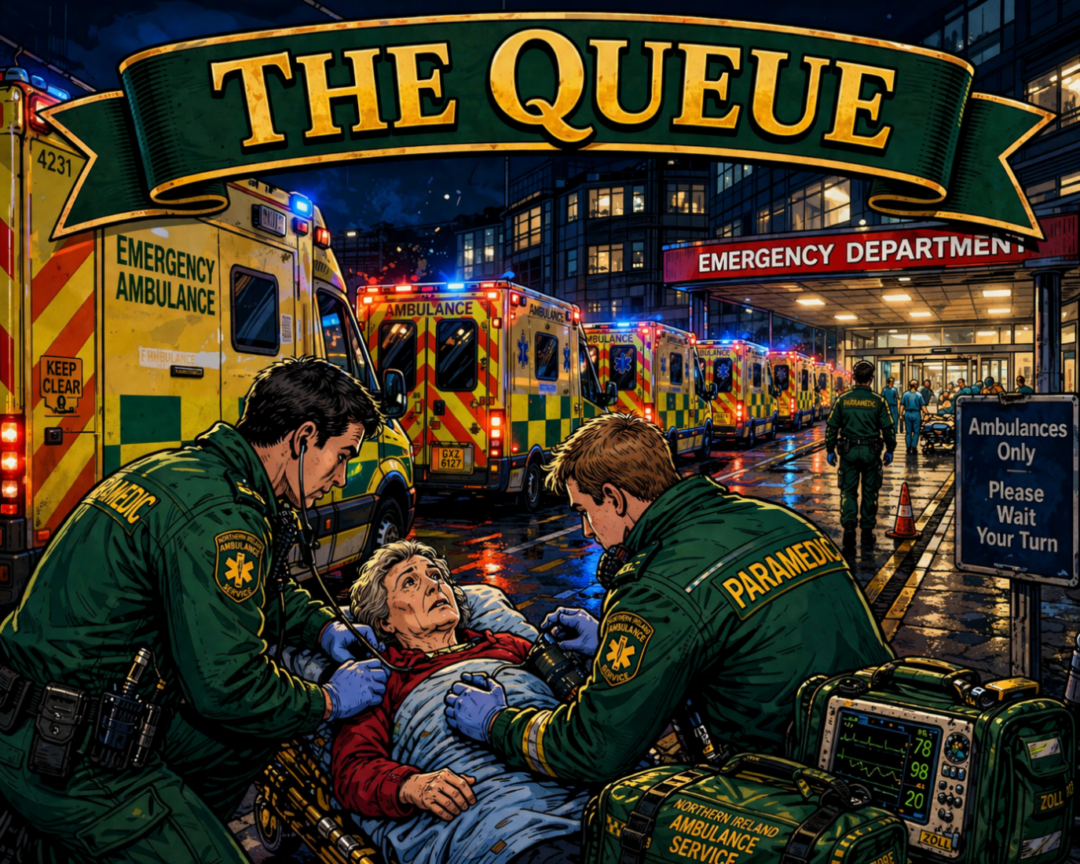
Nobody tells you, when you join the ambulance service, that a significant part of the job will involve sitting still. Not the stillness of a quiet shift or the brief pause between calls when you get back to the station and eat something before the tannoy goes again. A different kind of stillness. The kind where the engine is running, the uniform is on, a phone is ringing somewhere out there, a person is waiting, and you are parked outside a hospital, unable to do anything about any of it.
It was never like this.
People see the queue now and assume it has always been part of the job. It has not. Nineteen years ago, when I started in the ambulance service, waiting at the hospital was virtually unheard of. You brought the patient in. You gave your handover. The patient moved across to a hospital trolley. You cleared. The whole thing took several minutes. It did not matter whether you were at the Ulster Hospital, the Royal Victoria, the Mater, or the now closed emergency department at the Belfast City Hospital — the process was the same, and it worked. You arrived, you handed over, you left. That was the job. That was how the system functioned.
Most people still have that picture in their heads. You call. We come. We take you to the hospital. Care continues inside. From the outside, it should look like a straight line — seamless, immediate, one thing following neatly from the next. And for a long time, it was. The gap between arrival and handover barely existed. It was not something you thought about, because there was nothing to think about. You pulled in, you walked in, the department took the patient, and you were back on the road.
Then the calls increased. The departments got busier. The beds got fuller. And the straight line began to bend.
It did not happen overnight. It crept in. At first, it was occasional — a busy Friday night, a winter surge, an unusually heavy run of admissions. You would arrive and, instead of being taken straight through, be asked to wait in the corridor. The corridor. Not outside, not in the car park. Inside the building, with your patient on the stretcher, parked along a wall between other trolleys, waiting for a bay to open up. It felt wrong at the time. It felt temporary, the way people describe a bad patch as temporary before it becomes permanent.
The corridors became normal. The waits got longer. And then cohorting began. When the department could not take patients individually, crews were asked to leave their patients together in a designated area or corridor, with one crew looking after three or four of them while the others cleared back to service. You would hand your patient not to the department but to a colleague already managing two others, and you would drive away knowing that the care your patient was now receiving was being shared among more people than any one crew could properly look after. It was a solution. It was also an admission that the system had moved beyond what it was designed to do.
I saw patients assessed in corridors, still on our stretchers. Sent to X-ray on our stretchers. Treated, reviewed, and in some cases discharged — sent home — without ever getting their backside onto a bed in the emergency department. The entire hospital journey, from arrival to discharge, was conducted on a stretcher in a corridor because there was no bed, no bay and no space to put them in. That is not an emergency department functioning under pressure. That is an emergency department that has run out of room to function at all.
Then Covid struck, and everything changed again.
The corridors were no longer an option. Infection control meant patients could not be kept in the department as they had been. The waiting moved outside. Crews stayed in their ambulances with their patients, parked in the bay or on the access road, waiting for word from inside that there was space to bring them in. The queue that had been invisible — hidden inside hospital corridors where the public never saw it — was now a line of ambulances in a car park, visible to anyone who drove past.
When the Covid restrictions eased, the queue did not go back inside. We continued to wait in the ambulances. The system had found a new way to manage the problem, and that new way stuck. Now, you bring your patient to the hospital, and you wait outside until the ambulance triage nurse tells you there is space to bring them in. That is the current reality. Not a temporary measure. Not a crisis response. The way it works now, shift after shift, day after day.
I want to tell you about a specific shift, because the general version of this story has been written many times, and it has not changed anything.
We had picked up a patient from a nursing home after a fall. They had a suspected fractured hip, were in significant pain, and were frightened in the way that older people are frightened when they realise they cannot get up from their own floor. We treated their pain. We reassured them. We got them onto the stretcher carefully, talking them through every movement, and we drove to the hospital with the reasonable expectation that we would hand them over, they would be seen, and we would be back on the road within the hour.
We pulled into the ambulance bay, and there were already ten vehicles ahead of us. Each one had a crew inside. Each crew had a patient. The bay was full, so we parked on the access road behind the others, and I went inside to let the triage nurse know we had arrived. She looked at me with the particular expression that emergency department staff develop when they have nothing good to tell you and no time to soften it. She said she would let me know. She did not say when.
I went back to the vehicle. My crewmate was sitting with the patient, adjusting their pain relief, keeping them talking. The patient asked how long it would be. I told them it should not be too long. That was not honest, and they probably knew it, but neither of us had anything better to offer in that moment than a lie that sounded like reassurance.
We sat there for six hours and forty minutes.
Six hours and forty minutes with a patient in their eighties on a stretcher in the back of an ambulance, in pain, needing an X-ray and a bed and the particular reassurance that comes from being inside a building that exists specifically to look after people. Instead, they had us, a vehicle, a car park, and a view of the back of an emergency department that could not take them. We monitored them. We adjusted their medication. We talked to them about their family, their nursing home, and the cat they used to have when they lived in their own house. We did everything two people in the back of an ambulance can do, which is considerable, but not enough when what the patient needs is a hospital bed.
During those six hours and forty minutes, the radio was not quiet. We could hear calls being dispatched. We could hear the gaps in coverage. We could hear, in the spaces between transmissions, a system running out of vehicles because the vehicles were here, in this car park, doing nothing. Somewhere in the community we were supposed to be covering, someone was waiting for an ambulance that was not coming, and we were the reason it was not coming, and there was nothing we could do about it.
That is the particular cruelty of the queue. It is not that you are idle. It is that you are prevented from doing the thing you exist to do, and you can hear the need for it while you sit there.
The patient was eventually taken inside. We cleaned the stretcher, restocked with blankets and sheets, and went back on the road. The next call was already waiting. We drove to it in the kind of silence that follows a shift where a large portion of the night has been lost to something that should not have happened.
Blaming the emergency department for the queue outside it is like blaming the bottom of a dam for the weight of water pressing against it. Anyone who has stood inside one of Northern Ireland’s emergency departments during a busy period knows that those teams are working flat out. I have handed patients over at the Royal Victoria, Antrim Area, Craigavon, Altnagelvin, and the Ulster Hospital. What I have seen inside those departments is not complacency. It is controlled exhaustion. People doing more than a system should reasonably ask of them, held together by professionalism and a commitment to the patient that outlasts the understaffing and the relentlessness of the demand.
The problem runs deeper. When patients cannot be discharged from wards because there are no care packages in place to support them at home, the beds on those wards do not become free. When ward beds are not free, patients waiting in the emergency department cannot be moved up. When patients cannot move out of the emergency department, there is no space to move our patients in. So we sit outside, one link in a chain that has seized up several links back, waiting for a movement somewhere in the system that will allow everything to shift forward.
Bed blocking. That is the clinical term. It is a dry phrase for something with very human consequences. It means the patient can be in the emergency department for 12 hours or even days because no bed is available. It means the ward patient is ready to go home, but cannot because the care package has not been arranged or is unavailable. It means we stay outside in the car park. It means the call in the community that nobody has reached yet. It means the patient with the fractured hip, lying on a stretcher in the back of a vehicle for six hours and forty minutes, wondering why they are not inside.
Northern Ireland faces particular pressures that make all of this harder. The geography alone sets this place apart. I have worked calls in areas where the nearest emergency department is a long drive away under normal conditions. When the one ambulance serving that area is held at a hospital for several hours, the community it covers is exposed. The distance between rural Tyrone, Fermanagh or Down and the nearest acute site is not a number on a map. It is a reality that crews and communities live with every shift.
While the queue builds, the calls keep coming. The control room manages it as best they can — prioritising, rebalancing, sending whatever is available. But “available” is a shrinking term when a significant portion of the fleet is held outside hospitals. A cardiac arrest will get a crew. A major trauma will get a crew. But the person who has fallen and cannot get up, the older adult whose breathing has been worsening through the afternoon, the family that is frightened and does not know what else to do — they wait. And every crew knows that a call categorised as lower priority can deteriorate before anyone arrives. Every crew knows that the person waiting longest might turn out to be the one who needed them quickest. Unfortunately, some have waited that long that they have died.
The delay goes all the way back to someone sitting in their living room in Omagh, Newry, Derry, or Enniskillen, waiting for an ambulance that is not yet available.
Over time, the queue does something to the people who sit in it. A single long wait is frustrating. It becomes the story of the shift. But twenty of them, fifty, a hundred — it becomes something else. A slow erosion of what made the job meaningful. Not a sudden breaking point but a gradual wearing down, like water on a stone. You still care. You still want to be out there. But the gap between the job you came into this service to do and the job you are actually doing grows wider with every shift, and that gap has a cost.
I think about that cost in terms of what was lost along the way. Nineteen years ago, the job was the call, the patient, the hospital and the road. That was the rhythm of it. That was why you joined. Somewhere between then and now, the system broke in a way that inserted hours of stillness into the middle of a job built on movement, and the people inside the vehicles absorbed it because there was no alternative, and the people responsible for fixing it did not fix it, and the queue became the job.
When people leave — when the accumulation finally outweighs the commitment — the knowledge they carry leaves with them. It does not transfer to a file. It walks out the door. And the communities those people were trained to serve feel the gap, even if they never know exactly why response times are getting longer or why the vehicle that should arrive has not.
The queue is not the cause of the problem. It is where the problem becomes visible. Everything behind it — the full wards, the absent care packages, the delayed reforms, the years of political instability that left the health service without direction or adequate investment — all of that is invisible to the person standing in a car park looking at a row of ambulances going nowhere. What they see is the line. They may think something has gone wrong with the ambulance service. That conclusion is understandable from the outside. It is also wrong.
On the 27th April 2026, the ambulance service, in co-operation with all the other Health Trusts in Northern Ireland, introduced a new protocol called Release to Rescue. The principle is straightforward: a maximum handover time of two hours, after which the ambulance crew is released to return to service, and the patient becomes the responsibility of the emergency department. After one hour, the crew escalates through the Hospital Ambulance Liaison Officer (HALO) to senior ED staff. After two hours, the handover happens regardless. How and to whom the patients are handed over still remains to be seen.
On paper, it makes sense. Two hours is better than six. Getting crews back on the road means getting ambulances back into the community, back to the calls that are stacking up, back to the person in Omagh or Enniskillen who has been waiting. The national target is fifteen minutes. Two hours is not fifteen minutes, but it is a long way from six hours and forty minutes in a car park with a patient who should have been in a bed before the first hour was up.
But the protocol does not create beds. It does not discharge the ward patient whose care package has not been arranged. It does not add staff to emergency departments that are already running beyond capacity. It moves the patient from the stretcher to the department, and the department absorbs them, and the question that the protocol does not answer is what happens inside a department that was already full before the patient arrived. The queue outside the hospital may shorten. The pressure inside it does not. It simply changes location.
Release to Rescue is being described as phase one, with the fifteen-minute handover standard as the eventual goal. That goal is the right one. Fifteen minutes is what the system was built for. It is what crews experienced nineteen years ago without needing a protocol to enforce it. The question is whether the system behind the protocol — the wards, the care packages, the staffing, the investment — will change fast enough to make that goal achievable, or whether two hours will become the new normal the way six hours became the old one.
The purpose has not changed. It never does. To reach the patient. To care for them. To get them to where they need to be. That is what every crew on every vehicle is there for, shift after shift, year after year, through every queue, every delay, and every conversation with a patient who deserves a better answer than “not yet”.
Between the station and the patient, and between the patient and the department, the system is not working as it should. It used to. That is the thing worth remembering. It used to work. The handover took minutes. The stretcher was cleaned. The crew went back on the road. The patient got a bed. Nineteen years ago, that was not an aspiration. It was Tuesday.
Until the decisions are made — real decisions, with funding, commitment, and accountability behind them — the queue will remain. And the crews will sit in it. Doing the job as best they can. Waiting for a gap to open that should never have closed in the first place.